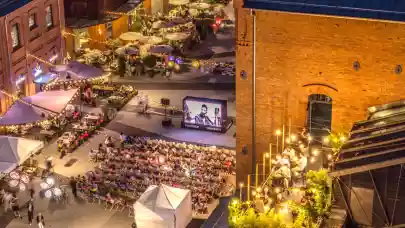
Poland has transformed former industrial sites across six cities into some of Europe's most compelling mixed-use destinations, marking the country's evolution from economic catch-up to urban innovation leader, according to a new Urban Land Institute (ULI) report.
Since joining the European Union in 2004, Poland has delivered the highest cumulative economic growth of any OECD country, outperforming Ireland, South Korea, and every G7 nation. Unemployment has fallen from over 20% in the early 2000s to the lowest rate in the EU. Six Polish cities rank among Europe's 15 fastest-growing urban economies over the same period.
This transformation is now written into the cities themselves. Across Warsaw, Łódź, Poznań, Gdańsk, Gdynia, and Wrocław, former factories, breweries, shipyards, and post-industrial sites have been remade into mixed-use destinations where people live, work, eat, and spend time within single urban structures that preserve the bones of what came before. "Urban destinations are no longer a niche experiment in Poland – they are a proven concept, and a core part of how cities grow and how capital is deployed," says Maximilian Mendel, ULI Poland Member and Managing Partner at Sphere Asset Management.
In Łódź, a 25-hectare textile factory that once employed thousands now draws millions of visitors a year as one of Central Europe's most visited destinations while retaining its original brick halls, factory chimneys, and industrial courtyards. In Gdańsk, a new mixed-use district is rising on the former shipyard where the Solidarity movement was born.
The projects profiled in the report share common characteristics: all are built on heritage sites rather than greenfield developments, and each combines multiple uses within single open structures integrated into surrounding cities. "For years, Polish cities were described mainly through the lens of rapid growth and catching up. This report shows the maturing of a distinct urban development model in which private projects increasingly create fully fledged parts of the city," says Marcin Juszczyk, Chairman of ULI Poland.