An urban regeneration project in Stavyshche, Ukraine, will transform a former school building into housing for families displaced by the war. The initiative, called Dvir – the Shared Courtyard, has been designed by Office for Future Landscapes and is being developed by the Charity Foundation Housing for IDP.
The project will convert the 1,900 sqm building into 42 apartments of various sizes, complemented by 200 sqm of shared indoor spaces. The development is intended to provide accommodation for families who have been forced to leave their homes due to the conflict while also supporting community integration.
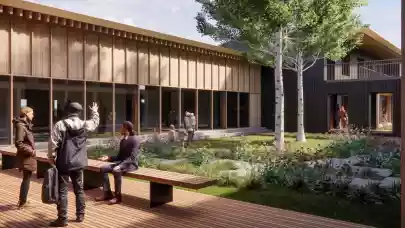
For decades, the building served as a local school and remains an important landmark for the town. Under the redevelopment plans, it will become a residential micro-community that remains connected to the wider city through a range of communal facilities. Shared areas, children's play spaces and meeting rooms are designed to encourage interaction between residents and the local community. The common spaces will also be available for cultural activities and public events.
The architectural concept focuses on the adaptive reuse of the existing structure while incorporating sustainability measures. The former asphalt-covered courtyard will be converted into a green permeable space, while the roof will be equipped with photovoltaic panels intended to provide a high degree of energy self-sufficiency for the community. Approximately 800 sqm of solar panels are planned as part of the project.
"We asked ourselves how this place could best welcome people who have experienced the trauma of losing their homes," said Paolo Russo, Founder of Office for Future Landscapes. "Our goal was to create high-quality living spaces for the new residents while also offering the city places where people can meet, connect and share experiences. Through this intervention, architecture becomes a tool for social reconstruction."
The development will include four housing types, ranging from studio apartments to three-bedroom units, as well as fully accessible apartments for people with disabilities. In total, the project is expected to provide homes for 42 families.