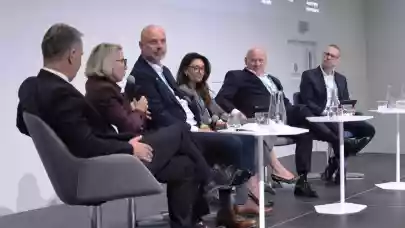
At Prague Property Forum 2026, industry leaders from across the property and facility management ecosystem examined how digital tools are changing the way buildings are operated, valued and experienced. The discussion moved beyond the usual AI hype to focus on the real challenges behind transformation: organisational culture, data quality, workforce readiness and the growing expectation for buildings to function as responsive service platforms rather than static assets. While technologies such as AI, automation and occupancy analytics are advancing rapidly, the panel agreed that long-term success will depend less on the tools themselves and more on how effectively companies integrate them into everyday operations, decision-making and user experience.
Hubert Abt, CEO, workcloud24, argued that the market has already “voted” for smarter, higher-quality space, pointing to examples where tenants downsize their footprint but pay significantly higher rents for better infrastructure and operational excellence. He stressed that buildings offering smart, well-managed environments can command 20–30% rent premiums, even in markets with high vacancy in comparable stock. However, he warned that the real estate sector still lacks the cultural shift needed to fully exploit data and technology, noting that software projects frequently fail when organizations try to buy solutions without first changing mindsets and management practices. For Abt, operational data should be tied directly to asset value, risk and user satisfaction, positioning buildings as service platforms rather than static financial collateral.
Drawing on her experience at SINGU, Anna Bartoszewicz-Wnuk described a rapid maturation of digital practices in CEE, especially in Poland, where tenants and public sector clients are now actively demanding CAFM and data-driven tools. She highlighted how AI is moving from vision to practice in facility management: from reading inspection protocols and pre-populating work orders to acting as a co-pilot that surfaces portfolio insights, capex hotspots and defect patterns on demand. Anna emphasised that technology deployment has shifted from isolated IT projects to company-wide change management programmes, requiring training, internal champions and long-term governance. She also underlined the commercial value of data: better information on performance and maintenance is increasingly being used to negotiate with landlords and vendors, optimise portfolios and improve transaction outcomes.
Michaela Klesnarová, Vice President, IFMA Czech Republic, stressed that while technology in buildings has advanced quickly, education, compensation and adoption among facility professionals have not kept pace. She argued that facility managers and on-site staff are expected to support increasingly complex, data-rich environments, yet are often poorly paid and insufficiently trained to use the tools provided to them. In her view, AI and automation should be used to remove repetitive tasks and elevate facility roles toward higher-value, more qualified work—provided the industry invests in upskilling and rethinking career paths. Michaela also noted that many real estate players have vast quantities of data but lack the capabilities to interpret and apply it, leading to a cycle of innovation spending without corresponding operational or financial gains.
Speaking from the occupier perspective, Marek Kurc, Portfolio Manager at Tieto, explained how data-driven facility management is becoming central to portfolio strategy, especially in a context of widespread remote work. He described using occupancy sensors and access control data to assess actual office utilisation and support negotiations for downsizing or reconfiguring space, directly linking workplace metrics to cost savings. Marek illustrated how AI is already embedded in design processes, citing an office relocation project where AI-generated layout proposals served as the starting point for the final concept. For corporate tenants, he concluded, digital tools are no longer optional add-ons but essential instruments for aligning real estate footprints with changing work patterns and financial objectives.
Tamás Méri, Co-Founder, Access4you, framed accessibility as both a social imperative and a data opportunity, arguing that the needs of the 15–16% of the population facing barriers in buildings can be systematically captured and translated into actionable metrics. He contended that real estate remains far behind other sectors, such as agriculture, in terms of automation and digitalisation, partly because of split incentives between developers and operators and the long lifecycle of assets. By digitising accessibility information and integrating it into building evaluations, Tamás believes owners can improve user experience while training themselves to respond to diverse and evolving needs—a skill that will be critical as the industry faces accelerating structural and technological change. He also noted that, at least in accessibility, Europe is ahead of the US both in regulation and in the sophistication of digital solutions, showing that the region can lead in specific niches of property innovation.