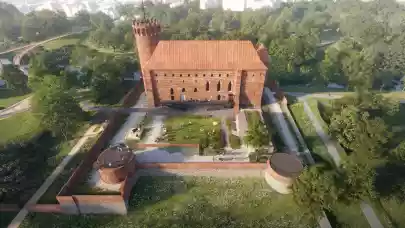
The city of Świecie, a town in northern Poland's Kuyavian-Pomeranian Voivodeship, has unveiled a comprehensive masterplan for the revitalisation of its 14th-century Teutonic Castle, viewing the historic fortress as the foundation for a new cultural and educational identity rather than merely a medieval relic.
The concept was prepared by APA Wojciechowski Architekci with strategic advisory from The Making. Their analysis extends beyond the castle to include its relationship with the town square, the Vistula river valley panorama and the nearby Natura 2000 protected landscape.
"From the outset we adopted a holistic approach. We analysed visual axes, connections with the town square, circulation and the landscape of the Vistula valley, treating Natura 2000 as a structural value of the site rather than a constraint," explains Szymon Wojciechowski, architect and CEO of APA Wojciechowski Architekci. The project introduces modularity, allowing individual components to be implemented independently while remaining part of a coherent whole.
Mayor Krzysztof Kułakowski emphasises the strategic dimension: "Our intention was not only to adopt a comprehensive perspective that clarifies development directions and increases the feasibility of the project, but also to create a coherent narrative that will guide this process consistently in the years to come." The city has adopted a phased approach, currently focusing on castle revitalisation and recreational area development, with further components to be implemented gradually.
Monika Tom, director of Centrum Kultury w Świeciu, highlights the long-term vision: "We needed a document designed for the long term — coherent and with clearly defined directions. This study provides stability and a durable foundation for the entire castle area." The masterplan treats the castle area as a system bringing together heritage, landscape, education and tourism within a single development vision.