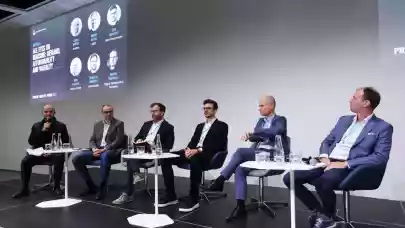
At Prague Property Forum 2026, the residential panel, chaired by Radek Kučera, brought together leading public and private-sector players to dissect why Prague’s housing remains so expensive and what it will take to change course. The discussion revolved around sluggish permitting, structural undersupply, land policy, the role of institutional capital, and the capacity of the construction industry to scale up.
Martin Červinka, representing the Prague Development Company, described the city-backed developer as a “public sector experiment” tasked with building on municipal land. He highlighted that even a city-owned company enjoys little real advantage in the permitting process: their first major project in Dolní Počernice only recently obtained zoning approval after roughly two years of complex negotiations over ownership and city council decisions. Červinka pointed to cumbersome public procurement rules and tax settings as major barriers, noting that municipalities pay higher VAT on soft costs than private developers, undermining efforts to support affordable housing. Despite these obstacles, his team has grown rapidly and aims to secure building permits for around 3,000 units within two years, signalling the city’s ambition to be a more active market player.
Stanislav Kubáček of Heimstaden brought a comparative European perspective, arguing that Prague’s affordability crisis is fundamentally a long‑term supply problem. In contrast to cities like Warsaw, Helsinki or other Nordic and German markets where Heimstaden operates, Prague has been delivering only a fraction of the new apartments per capita for decades, which has inevitably pushed both rents and prices to the top of the regional league. He stressed that policies matter: some countries have managed to “crack” housing better through consistent planning, infrastructure and incentives for municipalities to zone and permit more residential space. Kubáček believes the recent emergence of institutional capital and policy debates is a step forward, but warns that without sustained higher delivery – not just 5,000 but closer to 8,000–10,000 units annually – younger generations will continue to be priced out or forced into long commutes from Central Bohemia.
Erik Janovský, partner at Mint Investments, outlined how his firm is building a Czech rental housing portfolio almost from scratch in a market historically dominated by individual ownership. Mint is currently working on around 3,000 flats in Prague and Brno, but Janovský underlined that bringing a single build-to-rent (BTR) product to market typically takes five years, given lengthy underwriting, redesign with developers and construction. He described how Mint collaborates intensively with developers for 12–18 months to “re-engineer” projects – often increasing unit counts and focusing on smaller, more efficient apartments that match the fast-growing share of single-person households. Janovský added that Brno’s new master plan has unleashed a wave of new opportunities, and developers are now actively seeking Mint’s know‑how in designing rental-ready districts from day one – but investment decisions will still be constrained by whether projects can generate acceptable returns in today’s cost and pricing environment.
Igor Klajmon, Chief Development Officer at Sekyra Group, spoke from the vantage point of a large-scale urban developer behind Prague’s flagship regeneration areas such as Smíchov City, Rohan and Žižkov. He characterised the permitting environment as a “never-ending story” that has featured on every industry agenda since the last major building code change in 2006, and he placed strong hopes on the upcoming construction law and new metropolitan plan to at least streamline legal processes and bring more stability. At the same time, Klajmon warned that even if planning rules were suddenly liberalised and land unlocked, the market currently lacks sufficient design and construction capacity to double housing output overnight. Sekyra already works with dozens of architecture and engineering firms and struggles with delays, cost overruns and contractors unwilling to fix prices, so any legislative reform must be matched by a stronger talent pipeline and a more attractive image for what he called a “dirty” but vital industry if future generations are to find homes they can afford.
Marek Blaha, CEO of Dostupné bydlení České spořitelny, presented the bank-backed affordable housing initiative as proof that significantly lower rents are achievable with the right timing, capital and partnerships. His platform already owns around 1,000 discounted apartments, including a recent project in Prague’s Černý Most where monthly rent levels were driven down to roughly €600-equivalent, and it is targeting an expansion to about 3,000 units representing some €600 million of investment. Blaha explained that the fund took a contrarian stance during the 2022 downturn, using its access to cheap, long-term capital to buy when others were hesitating, which now underpins its ability to offer lower rents. Looking ahead, he argued that Vienna-style models – where municipalities control more land and use it strategically for housing – and better use of tools like pension funds in rental and affordable schemes will be essential, especially given rising interest rates and the competition from government bonds for investors’ money.