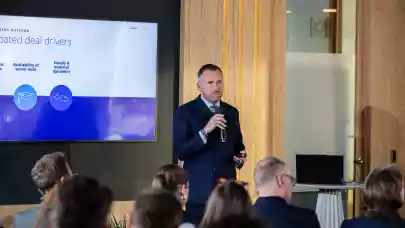
Speaking at the CEE Property Investment Update 2026 conference in Warsaw, Piotr Mirowski, Senior Partner and Head of Investment Services at Colliers, delivered an optimistic assessment of the region’s investment outlook. After two challenging years marked by higher financing costs and subdued activity, CEE has begun to stabilise, with investors adapting to a reshaped market environment rather than waiting for a full return to pre-2022 conditions.
Poland and its neighbouring countries now account for roughly 5% of Europe’s total investment volume. While fundraising and overall sentiment are gradually improving, the recovery remains uneven. Local markets, especially the Czech Republic, have emerged as high-performing hubs, recording unprecedented investment activity. Last year, Czech real estate deals matched Poland’s volume, marking a historic shift.
A prominent trend is the increasing importance of domestic and regional capital. As foreign capital retreated, local investors - family offices, individuals, and regional funds from the Czech Republic, Hungary, Austria, and the Baltic States - have stepped up, filling the gap and delivering approximately €1.1 billion in transactions in Poland alone. These groups seek capital preservation rather than high-risk, high-return strategies, helping to stabilise the market.
Office assets have made a surprising comeback, taking the largest market share, followed closely by logistics. The market landscape has permanently changed. Deal sizes are smaller, investors are more diverse, and many traditional market-makers have been replaced by a broader array of buyers.
Several positive factors support the region’s growth: strong economic performance (with 3.5% growth forecasted for Poland in 2026), greater debt availability facilitating more transactions, and promising domestic demand across asset classes. However, the market remains volatile, and geopolitical tensions still cast uncertainty over long-term prospects.
Looking ahead, regional capital is expected to remain the primary force driving investment until broader stability returns. Investment managers are already creating vehicles to attract high-net-worth individuals, ensuring that local equity continues to fuel market activity.
Overall, the CEE investment market’s ability to reinvent and rebalance itself is cause for optimism. With steady domestic investment and cautious but sustained momentum, the region is well-positioned for ongoing revival and growth.