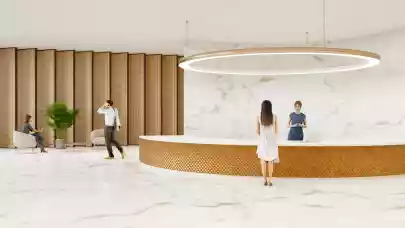
The appearance and functionality of a building’s reception area is in many cases the first impression of a company that potential clients and business partners will see. Do you remember the lobbies that truly impressed you? In the same way, you probably haven't forgotten those that did exactly the opposite. Smart systems in the reception area can enhance a positive experience, solve several problems and improve collaboration across departments. Can your receptionist do that too? Katarína Karmažinová, PR Manager at Colliers in the Czech Republic asks the question.
The first impression can be a stumbling block
The reception area represents the client's first contact with the company. “Unfortunately, even today it is true for many companies that their reception and the entire system of handling visitors does not look very elegant and is not even fully functional,” said Marek Rackay, Senior Project Manager at the Building Consultancy team at Colliers Czech Republic. “Sometimes you are greeted by a beautifully designed interior. At the door, however, there is an unenthusiastic receptionist and a bored security guard. In such cases, the first impression is not ideal.”
On the other hand, when you enter a building, greeted with a smile from the receptionist, your favourite beverage waiting for you because the property team already knows your favourite afternoon drink, it will leave you with a very different feeling. But even this may not be enough to ensure an overall good experience, especially when the entire reception process gets extended by the receptionist making you sit and wait while they dial your host to confirm your name and invitation.
“This is exactly the kind of situation we wanted to react to. The visitor is registered on a tablet using a QR code shared by the host alongside an invitation in their calendar. The extent of the reception desk experience is receiving an entrance card. For the host, this also means that when the visitor arrives, she receives a notification. There is no need to wait for a call from the receptionist. Hence, the whole operation takes only a few seconds,” said Petr Bořuta from Spaceflow, a company that developed a visitor system as a supplement to its primary product – the tenant experience application.
The empty chairs phenomenon
Even when COVID-19 restrictions were eased and with a relatively high percentage of the population vaccinated, there has been still a considerable number of closed offices on the Prague market, especially multinational companies.
“Smaller companies are divided into two groups,“ said Marek. “The first are those companies that dealt with the Covid situation minimally after their return and did not implement any major measures. The latter, like us at Colliers, restricted access to the offices and provided a system in which employees rotate regularly. There is also a model in place in which people are divided into groups. One group comes to the office every day and some employees work remotely.”
According to Colliers’ Workspace Advisory team, it was quite common before the pandemic that in companies with a thousand or more employees in offices, usually only 40 percent of people were physically present. The rest work remotely or are in meetings with clients, take personal time off and so on.
“With a large number of clients, we encounter a unique post-COVID phenomenon, with employees returning to offices very slowly and therefore the occupancy of the space also increasing very slowly. As a result of that, managers at occupier firms are seeking different ways to bring back employees to the offices,” added Marek.
Technologies are advancing and amongst other areas, COVID-19 has shed light on the efficiency or inefficiency of office spaces. Empty chairs and a change in work style are leading more companies to think not only about how much space they need but also how to use the reception area as effectively as possible.
“In larger companies, we can already see changes in the functioning of reception areas,” says Lukáš Litera, director of the Building Consultancy department at Colliers. “Previously, three receptionists were no exception, taking turns not only in receiving visitors but also booking cars, desk seating, meeting rooms, business lunches and dealing with mail. Today, this agenda is being moved to automated smart systems, where all the requirements related to day-to-day operation are being arranged with one simple click.”
“Who did you meet with yesterday?”
At Colliers, we worked with Spaceti, Spaceflow, or Sine systems. These facility management systems or tenant experience applications can tailor their software to the needs of individual companies or landlords.
In the advisory consulting process, we use, for example, the touchONE reservation system, which allows companies, regardless of the size of the premises, to reserve all rooms using dozens of touch panels that can be connected to the main panel, for example at the reception. The installed touchONE system then provides the entire reservation system for dozens of rooms. The touchONE system also takes care of ordering coffee or sandwiches for a specific time in a specific meeting room.
“Regarding visits to the building, in the vast majority of cases it is so simple that a single tablet is enough and in cooperation with one receptionist, the visit is registered in a system that clearly shows which visitors are expected by whom in the building or when and where they will sit,” Marek explained. Smart systems in buildings also allow managers to review data about the circulation of guests.
If no one in the company has an actual overview of what kind of visitors move throughout its offices every day, they are losing valuable information. In addition to security factors, an overview of visitors can be key to better collaboration between departments and for business development. “Colleagues at Colliers pass on information about who knows whom and cooperates with them, and many times this information is really helpful for colleagues and develops effective networking,” explained Marek. “Who did you meet with yesterday?” is often a question of importance for business development teams.
“Our clients also use anonymized booking data to understand what spaces to focus on for renovations or new buildings - how large should the meeting rooms we build be, and what equipment is most popular,” added Petr from Spaceflow.