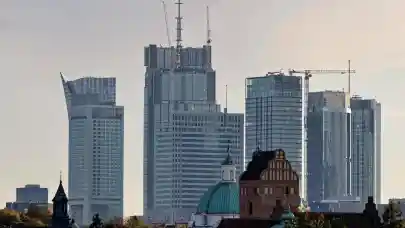
Warsaw's office market is experiencing a supply gap that has deepened since 2023. Only around 28,000 sqm of new office space is expected to be delivered by the end of 2026, making it one of the lowest annual supply figures on record for the capital. Rising construction costs, more expensive financing and greater investor caution continue to restrict new development, with no significant recovery anticipated until 2028. At the end of the first half of 2026, around 130,000 sqm remained under construction, with more than 90% of projects located in central zones.
Despite constrained supply, occupier activity reached 420,000 sqm in the first half of 2026, a 38% increase year-on-year. Average vacancy across Warsaw fell to 8.5%, down 2.3 percentage points year-on-year. In central locations the rate dropped to 4.8%, while in the Rondo Daszyńskiego area it stands at just 3.6%, a level consistent with markets where availability is severely constrained. Headline rents in central zones currently range from €15 to €28 per sqm per month, rising to €25 to €32 per sqm per month in the most sought-after schemes, while incentive packages offered to occupiers are gradually being reduced.
"Warsaw's office market is entering a very different phase from the one we observed immediately after the pandemic. Today, the challenge is not a lack of demand, but the declining availability of modern office space in the best locations. In the city centre in particular, the choice of large, high-quality units is shrinking rapidly," said Sara Romanowska, Senior Advisor, Office Agency at AXI IMMO. She added that occupiers planning a relocation should start the process much earlier than they did just a few years ago.
The decline in vacancy is not driven solely by occupier demand. Owners of older buildings that no longer meet current technical or environmental standards are increasingly choosing to modernise them or convert them to alternative uses, most commonly residential, further reducing the available office stock. "Falling vacancy does not mean that every building automatically becomes more attractive. The market is becoming increasingly polarised. Occupiers are focusing on modern, well-located and energy-efficient projects, while older properties need to compete through refurbishment, upgrades in standard or more flexible commercial terms," Romanowska noted.
The trend is also visible beyond Warsaw, with vacancy falling in central locations of regional cities including Kraków, as developers across Poland limit the launch of new projects. Demand in regional markets remains stable, supported by the business services sector, IT companies and organisations maintaining hybrid working models, leading to faster absorption of available space. Warsaw, however, remains the most advanced example of this dynamic, with availability in the city centre contracting faster than in regional markets.
"Over the next two years, one of the most important criteria in occupier decision-making may no longer be the rental level itself, but the availability of suitable space. Companies seeking large, modern offices in the best locations will need to plan their requirements further in advance," Romanowska concluded. With new supply in 2027 expected to reach a multi-year low and a recovery in development activity not anticipated before 2028, availability of quality space is set to become an increasingly decisive factor for occupiers in Warsaw and other major Polish office markets.