Recently, market focus has been on new high-rise office developments which are reshaping Warsaw’s skyline and attracting tenant interest. Analysis of market data reveals, however, that office campuses have enjoyed the strongest occupier demand, says Cushman & Wakefield. Although they make up around 10% of Warsaw’s office stock, they accounted for as much as 16% of total take-up in the city in the first half of 2024. What criteria does an office project have to meet in order to qualify as an office campus and what makes office campuses so popular?
An office project must meet several conditions to qualify as a campus. Condition number one is scale – an office complex has to be large. Although there is no definitive minimum size, office complexes offering less than 40,000 sqm of office space can hardly be categorised as campuses in Warsaw.
"Another condition is that an office complex must provide a wide range of amenities for tenants so that it is almost independent of its surroundings or seamlessly complements them. It should essentially offer campus users everything they need from an office complex on a daily basis: cafés, restaurants, gyms, conference centres, clinics, kiosks, car washes or beauty services. With such amenities available on-site, an office fits into the theory of a ‘third place’, providing not only workspace but also leisure options”, explains Piotr Capiga, Deputy Head of Occupier Services, Office Department, Cushman & Wakefield.
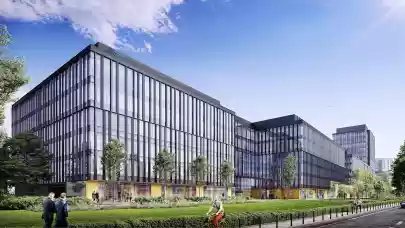
Low-rise, horizontal buildings are another hallmark of office campuses. They are less overwhelming in scale, and their expansive ground floors can easily accommodate additional amenities. In addition, such design minimises issues such as excessive shading or airflow disruptions which may be a concern in areas with densely packed high-rise buildings.
"The term ‘campus’ is naturally associated with academic centres, and rightly so, as the concept of an office campus is modelled after such educational institutions where a variety of functions are integrated within a single complex. Beyond providing office workspace, office campuses can serve as venues for social interactions and relaxation, fostering more opportunities for employees to share ideas and experiences. The most sought-after feature of office buildings is a blend of diverse and accessible green areas with an urban atmosphere of internal shopping and service walkways. As a result, an office campus plays a placemaking role, thereby welcoming local residents and visitors”, says Marcin Miazek, Associate Director, Office Department, Cushman & Wakefield.
The scale and multifunctionality of campuses attract tenants
With their large scale, office campuses can accommodate even the biggest tenants, providing the space they need today and the flexibility to expand as their business grows. They are typically developed in phases to meet the needs of tenants reporting rapidly growing office space requirements. In addition, vast campuses foster the creation of a diverse business environment.
"Pandemic-induced changes coupled with an extremely low unemployment rate have made employee expectations and well-being increasingly important factors in selecting office space. The office can significantly impact the choice of employer, with an attractive location being a key HR tool. In addition, with hybrid work setups being quite common, amenities can be an important incentive for employees to come to the office more often, which is welcomed by a vast majority of organisations. Therefore, functional yet inviting campuses surrounded by greenery are an optimal location for many companies”, explains Piotr Capiga.
Horizontal buildings offer very practical business advantages by providing tenants with large floorplates, eliminating the need to duplicate support functions across several floors. This improves space efficiency and facilitates interaction between departments, which strengthens organisational culture and enhances communication.
"LIXA offers large floorplates, some in excess of 3,000 sqm, giving tenants full flexibility in arranging workspace and significantly facilitating communication between departments within a company. This is greatly appreciated by our clients, many of whom looked for alternatives to office towers. Navigating between LIXA buildings feels like being at a university campus. Office buildings are typically associated with small adjacent areas, sometimes a plaza or a patio. LIXA is quite different - it features approximately 5,500 sqm of biodiverse green areas. Another hallmark of LIXA making it campus-like is the concept of LIXA City Gardens, which creates a completely new urban fabric and a unique public space open to everyone looking for an unusual place to spend time and relax. Within this concept, we have designed 4,000 square metres of modern space on the ground floors of the buildings (including along the 150-metre-long alley), featuring numerous retail, service, and dining establishments. It is also worth noting that LIXA is an open project with no unnecessary fencing, allowing for easy movement within the block bounded by Kasprzaka, Karolkowa, and Giełdowa streets”, comments Marta Zawadzka, Leasing & Asset Management Director, Yareal Polska, which developed LIXA - the latest office campus project in Warsaw.
Campus offices are nearly a third larger than the Warsaw average
Office campuses in Warsaw offer 630,000 sqm of modern office space, accounting for around 10% of the capital’s total stock. The average building size is approximately 11,000 sqm. Most are four- to six-storey high, but some in more centrally located complexes are higher.
In the first half of 2024, office letting activity reached approximately 716,400 sqm, of which 51,800 sqm was leased in office campuses across 41 transactions, accounting for 16.4% of total take-up. The average lease size in campus projects was 1,260 sqm, which was 31% larger than the average for the entire Warsaw market in the same period. New leases accounted for 19% of transactions, with renewals and expansions making up 81%.
In first six months of 2024, office campuses had a vacancy rate of 7.7%, well below the overall Warsaw vacancy rate of 10.9%.
Campuses in inner cities or near transit hubs
Inner-city campuses which are usually located on the fringe of city centres offer such amenities as excellent public transport accessibility and a vast array of retail and service options while preserving their buildings’ intimacy. Such projects are well integrated into mixed-use complexes which enhance the urban fabric by incorporating retail, hotel and residential functions, thereby serving as modern city lifestyle centres.
By contrast, campuses located on city outskirts enjoy easy access to expressways, motorways and airports, which is why they are very often favoured by tenants with mobile teams or large vehicle fleets. Another distinctive feature of such complexes is their well-designed landscape with plenty of greenery ensuring a comfortable employee experience.
What all campus projects have in common is large floorplates and amenities supporting modern workplace strategies focused on fostering openness, inclusivity and collaboration. Additionally, campus projects offer more parking spaces per square metre of office space compared to office towers or standalone office buildings.