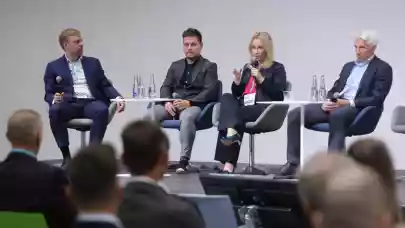
As higher financing costs and slower economic growth force investors to become more selective, resilience has become one of the most important themes in real estate. But what makes an asset truly resilient today? Speakers at the closing panel of Prague Property Forum 2026 argued that the answer lies in adaptability, strong fundamentals and the ability to meet changing occupier needs, regardless of sector.
Chairing the debate, Pavel Streblov, Managing Director at Penta Real Estate, framed the discussion around how to secure “resilient returns” as markets digest higher interest rates and changing occupier demand. He highlighted Penta’s strategy of combining standing income-producing assets with development projects, which allowed the firm to deliver around 15% returns in its real estate portfolio last year. Streblov argued that multi-use, flexible schemes – especially in residential – offer an advantage because they can be repositioned between sale, rental, student and other living formats as demand shifts. At the same time, he cautioned that over‑specialisation in narrow residential sub‑segments, such as student housing or very specific build-to-rent formats, can reduce adaptability when cycles turn.
Tomáš Dadej, Head of Real Estate Development in the Czech Republic at Kaufland, underlined the role of hypermarkets as traffic-driving anchors that underpin entire retail schemes. Although customer behaviour has not fully returned to pre-COVID patterns and Prague underperforms some regional locations, he sees stable, recurring footfall across the network and views grocery leases of 15–30 years as a strong foundation for investors. Online grocery is gaining share in Prague but still represents a relatively small part of the market, and Dadej believes physical stores will remain dominant as shoppers want to see products and receive in-person advice. Looking ahead, Kaufland plans major refurbishments of older stores, selectively reducing sales area to add complementary retail and services, and exploring more intensive, mixed-use redevelopment of well-located “box” sites in big cities while preserving the brand’s broad assortment.
Representing Invesco Real Estate, Anna Duchnowska said institutional investors have become far more cautious, with alternatives like private credit, infrastructure and bonds competing directly with real estate. In this environment, capital gravitates either to assets with very predictable, inflation-linked income from strong tenants on long leases, or to higher-risk value-add and development strategies where clear upside can be created. She was notably sceptical about generic shopping centres, stressing that only dominant, expertly operated schemes or truly convenient formats are likely to deliver sustainable returns, while many mid-tier malls will need to be reconfigured into entertainment, convenience or other uses. Duchnowska sees convenience retail, PRS/residential-for-rent, and data centres as key long-term themes, and said investors are increasingly focused on manager governance, ESG, data quality and global execution capability when choosing partners.
Martin Makovec of Unibail-Rodamco-Westfield argued that physical retail is “here to stay” and, when well-managed, can regain market share even after the rise of e-commerce. He described a widening gap between top-tier “A-class” retail – large, destination centres in strong catchment areas with sophisticated operators – and struggling B- and C-class assets that lack clear purpose or scale. For Unibail-Rodamco-Westfield, value creation comes less from building new malls and more from enlarging and upgrading existing centres, including transforming them into Westfield-branded destinations that meet stringent requirements on size, tenant mix, services and connectivity. Makovec emphasised the growing importance of data, digital integration and high-quality F&B and leisure in shaping the customer journey, with physical and online retail increasingly functioning as a single ecosystem where stores often act as showrooms for digitally native brands.