Temperature measurements taken during the summer of 2024 and 2026 have demonstrated how vegetation affects surface temperatures in Bratislava during extreme heat events. At the Guthaus residential complex, the green roof recorded an average surface temperature of 49°C at 14:00 when air temperature was 33°C, but areas with growing vegetation on the substrate reached only 39°C. During an August heatwave with air temperatures of 40°C, the same vegetation reached 47°C. "It is still 10 degrees less than an asphalt or paved pavement in the centre of Bratislava," said Miriam Cánik, green space expert at developer CORWIN.
Measurements also showed that the density of greenery has a measurable effect on its surroundings. Tall vegetation in tree shade at Račianske mýto reached 40°C during the 2026 heatwave, while a lawn in the shade at the centre of a nearby park recorded only 37°C. Beyond midday surface temperatures, concrete and asphalt surfaces continue to emit stored heat at night, warming surrounding air even after sunset. "That is precisely what leads to the formation of urban heat islands, which are at night sometimes 10 degrees warmer than rural areas or localities with extensive greenery. Greenery not only heats up less, but also cools down much faster. It therefore plays a key role in combating extreme heat," said Miriam Cánik.
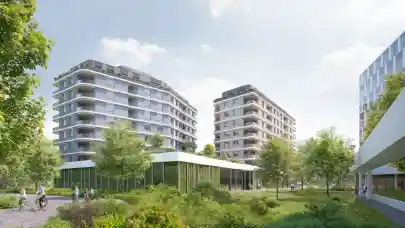
CORWIN focuses on brownfield development, converting neglected industrial sites that overheat their surroundings due to large paved areas and poor water retention. The developer has installed green roofs across all its projects, which, according to the measurements, are cooler and retain rainwater through their substrate layer, gradually releasing it through evaporation to cool the surrounding area. Rain gardens, which form part of the Guthaus complex, work on a similar principle.
"Green inner courtyards have proven very effective for us. They are not only cooler, but also significantly quieter than roads just a few dozen metres away. For example, the inner courtyard at Blumentál was up to 15 per cent cooler and 30 per cent quieter than the crossroads at Račianske mýto," explained Miriam Cánik. CORWIN plans to apply the same approach at its forthcoming Palma project, where low-rise green inner courtyards will form the core of the residential buildings, combined with green roofs, more than 15,000 sqm of greenery and rain gardens.