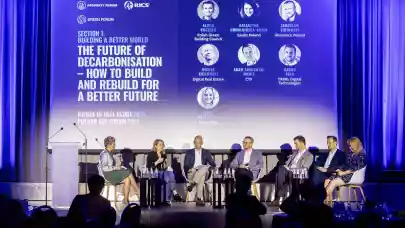
More action, less talking - this is how one can summarise “The future of decarbonisation - How to build and rebuild for a better future” discussion panel, which was a joint part of the conferences Future of Real Estate 2024 and Poland ESG Forum 2024, held last week in Warsaw. Both events were organised by Property Forum.
The task set for the panellists by its moderator, Alicja Kuczera, CEO of the Polish Green Building Council was to identify the most important problems slowing down the decarbonisation process in the Polish property market. As Kuczera enumerated, “Poland is a signatory to the Paris agreement, we are part of EU with a goal of climate neutrality by 2050. Within the Green Deal, there is a ‘Fit for 55’ package that gives us a set of numerous regulations. There is an energy performance directive that has just been changed; energy efficiency directive, construction products directive and so on. For the reporting part, we have the corporate system sustainability reporting directive, we have the corporate sustainability due diligence directive, we have the taxonomy, and there is a huge array of regulations that businesses have to follow. The real estate and the construction sectors have to do a lot in order to achieve climate neutrality, but it seems not an easy task in the dense forest of these regulations and requirements”.
Katarzyna Chwalbińska-Kusek, Head of ESG & Sustainability at Savills Poland was of the opinion, that it’s all about the holistic approach. ”We cannot talk about decarbonisation, sustainable buildings and minimizing the carbon footprint, only thinking about energy efficiency and CO2 emissions, without the water footprint, biodiversity, climate adaptability and even the user comfort. To change anything, we need to understand where we are and what data we have at hand. Those, who have data are the winners. That`s why on the corporate level, we start with an ESG due diligence process. In sustainable reporting, we talk about materiality assessment. We cannot tackle all the aspects with the same significance because we have limited resources. We need to use them well, so we need to understand the aspects that are material to our business model. And that's where we start. The materiality assessment is a key element and that's where the resources should be focused at”, said the expert.
Adam Targowski MRICS, Group Head of ESG at CTP did not agree with her. “It's not necessarily needed to do comprehensive analysis before we start doing significant things. We don't need to know how the building works to switch off the unnecessary lights. There is still a lot to be done, but it doesn't cost anything nor require any super detailed knowledge about the asset or the whole company. Let's grab a low-hanging fruit first. That's the thing that we have done differently already. Instead of waiting, developing analysis we really active in trying to decrease all the negative impacts of to develop the positive ones”, said Targowski.
His views were shared by Jarosław Fiutowski, Board Member for ESG Policy and Sustainable Construction at Ghelamco Poland. “The best option is simply to act and to struggle with the problem. We have been active in that battle for almost three years. We don't need, for example, to do reporting till 2026 for our assets, because all the necessary reports have already been prepared. To fulfil the requirements of providing energy to the buildings from renewable sources, we started to implement our own solar farms. At first, to reduce our carbon footprint, we checked where the biggest production of the CO2 is. We've noticed that 83% of the CO2 emission in the first year of use comes from embodied carbon. But after 60 years, 77% is coming out of the energy usage. We decided to focus on these two points and went into our own renewable sources. But at the same time, we are also trying to reduce the embodied carbon footprint. In one of our office buildings in Warsaw, we implemented the low emission concrete in the foundation slab which gave us a 10% reduction of the CO2 emission”, stated Fiutowski.
One of the other topics discussed during the panel was the introduction of sustained mobility to accelerate the decarbonisation of buildings. Gabor Toth, Chief Operating Officer at PARKL Digital Technologies noted that “there's the top-down approach to the regulatory side that we must comply with. But obviously, in recent years, there's also the pressure from the tenants, that are keen on moving towards their net zero targets and sustainable initiatives and want to make their office lives easier. And this is where sustainable mobility comes into the picture, as transportation is one of the largest polluters in our CO2 mix. The developers and asset managers are realizing that in the post-COVID era, the tenants are moving to better-quality office space. And they also realize that they need to comply with the technological advancements and green initiatives in order to attract those tenants into their buildings”.
Representatives of the proptech sector complained that awareness of the need for decarbonisation has progressed very slowly in the industry, with one of its biggest problems being technological backwardness. „I'm working with sustainability managers and we constantly have to cope with very simple things that are hard to manage. Most of the data is being collected manually. You don't have access to the meters, so you have no idea what your tenants are actually doing, what is the energy spent by leaving the equipment turned on overnight etc. In the new buildings, the situation is certainly easier - there is more knowledge there, so is also more space for experiments. But in the buildings older than three years, the access to the data is low”, said Michał Kozłowski, Co-Founder and ESG and Sustainability Lead at Digital Real Estate.
His opinion was shared by Anna Walkowska, Chief Technology Officer at ProperGate. “The most important thing is the cooperation between the investor and the construction company. I see a lot of challenges in terms of either not communicating or just ignoring any ESG requirements when briefing the contractors. In our case, we process information about materials and their transport from suppliers to the construction site. So we can tell you what the CO2 emission of the transport was and how this could actually be improved and optimized. But it looks like it's impossible in Poland. Although we have been talking about it for the last six years, only recently have two companies started thinking about it”, said Walkowska.