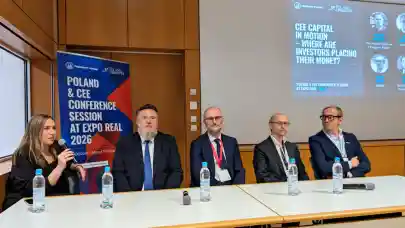
CEE's strong economic growth, improving liquidity and increasingly sophisticated local capital base are strengthening the region's appeal to real estate investors. At the Poland & CEE conference session at Expo Real 2026, panellists highlighted Poland as the region's benchmark market while pointing to opportunities across the Baltics and wider CEE, with offices, living, logistics and alternative sectors all attracting capital.
Emil Holmström, Chief Investment Officer at Eastnine, made a strong case for Poland and particularly Warsaw, arguing that the region's superior economic growth should continue to translate into occupier demand and rental growth. Eastnine has invested almost €800 million in Polish offices over the past five years, including major Warsaw acquisitions such as Warsaw Unit and The Bridge. The company is concentrating on high-quality, centrally located offices that can attract employees and support corporate culture, rather than treating the office market as a single asset class. Poland now represents 64% of Eastnine's portfolio, and Holmström sees enough potential in Warsaw alone for the company to triple its current €1.2 billion portfolio. While the recent rise in interest rates could temporarily slow transaction activity and trigger another period of price discovery, Eastnine's long-term conviction in Poland remains unchanged.
Ieva Vitaityte, Deputy Fund Manager at Capitalica, highlighted the growing role of Baltic and other regional capital in CEE. Capitalica's investor base, comprising mainly Baltic high-net-worth individuals and institutional investors, is increasingly prepared to move beyond its home markets, with Poland a natural destination. She argued that CEE should not be viewed simply as a collection of small and disconnected markets: countries increasingly share tenants, banks and investors, while capital is becoming more regional. Poland stands out for its maturity and liquidity, but opportunities are also emerging elsewhere, including regional cities where economic growth has not yet been fully reflected in real estate values. Looking ahead, Vitaityte expects investment returns to depend less on yield compression and more on securing the right entry price, identifying assets with NOI growth potential and finding motivated sellers.
Bartłomiej Kordeczka, Poland Co-Managing Partner at Pinsent Masons, described Poland as a highly active transaction market where deals are progressing across virtually every asset class, from logistics and student housing to data centres and energy storage. Investors and developers are increasingly exploring areas adjacent to traditional real estate, including infrastructure, energy and even opportunities connected to the defence sector. Within conventional real estate, Warsaw offices are benefiting from limited new supply and strong rental growth, while PRS still has significant room to expand. Retail parks remain active, although some investors are beginning to shift towards larger retail schemes, and logistics investment is picking up again after a period of weaker activity. Hotels and leisure are also growing steadily, led by Warsaw and Kraków. His message to investors amid renewed interest-rate uncertainty was to avoid returning to a wait-and-see approach and maintain investment momentum.
Paweł Malon, Group CEO at SINGU, focused on technology as an increasingly important component of real estate performance. He argued that Poland and the wider CEE region have moved ahead of many Western European markets in adopting digital tools for property and facility management, helped partly by the region's younger building stock. Technology can directly support asset value by improving operational efficiency, strengthening NOI and helping landlords provide a better product to tenants. Malon sees AI as another major enabler rather than a replacement for people, with the biggest opportunities coming from using data, automation and connected systems to make building operations more efficient. He also remains bullish on Poland's position as a technology and talent hub, arguing that the country's increasingly skilled workforce should help it adapt as AI changes more routine business functions.
Peter Noack, Managing Director & Founder at ZEITGEIST Asset Management, sees opportunities in combining long-term investment with the repositioning of existing buildings. The company specialises in giving older properties new uses and is applying this strategy to Warsaw's historic Telegraph development, where a former office building is being transformed into a modern, highly digitalised and ESG-focused workplace. ZEITGEIST is also expanding its exposure to PRS and student housing, where Noack expects continued growth as high homeownership costs and changing lifestyles support demand for rental accommodation. The company already operates residential projects across several Polish and Czech cities and around 2,000 student beds, with another 1,000 under construction. Looking beyond CEE, Noack said sentiment towards Germany at Expo Real appeared more optimistic than expected, with investors increasingly believing that the market may be close to its bottom. He expects German capital to return more actively within the next two years, with Poland likely to be among its first destinations.
The discussion, chaired by Richard Stephens, Executive Editor & Business Development Director at Property Forum, showed a CEE investment market increasingly supported by its own capital, economic growth and expanding range of investment strategies. Poland remains the clear regional reference point, but capital is becoming more mobile between CEE markets, while investors are increasingly looking beyond traditional sector and geographic boundaries. Higher interest rates may create some short-term friction, but the panel's broader message was that the region's convergence story remains intact, and investors willing to focus on income growth, operational performance and the right entry price continue to see significant opportunities.