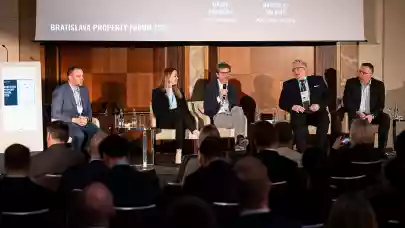
The residential panel at Bratislava Property Forum 2026 showed a market gradually stabilising after a period of sharp volatility, with rising costs, shifting buyer behaviour and structural imbalances continuing to shape both demand and supply. Moderated by Marián Škvarek, CEO of Realpad, the discussion brought together developers, financiers and investors to assess trends in Bratislava and regional cities, with a particular focus on affordability, the growing role of rental housing and the impact of technology and ESG on future projects.
From the banking side, Danka Morávková, Head of Real Estate Finance at Tatra banka, explained that residential remains a core, resilient asset class, even as financing conditions tighten. She highlighted that Tatra banka is currently monitoring 52 live residential construction projects and sees significant differences in construction costs between locations and project types, yet a surprisingly similar final price level for buyers. “We live again in a turbulent environment, but unlike 2022–2023, we are not alarmed about residential as a segment,” Morávková said. “Our task as a bank is to keep sufficient reserves, listen very carefully to our clients, and react flexibly, because we need you as much as you need us, in good cycles and bad cycles alike.”
On the development side, Radek Pšenička, Senior Business Development Advisor at YIT Slovakia, provided a data-rich overview of the Bratislava residential market, based on 15 years of active presence and detailed monitoring. He described how annual sales plunged to around 800 units in 2023—one of the steepest drops in twenty years—before rebounding to more than 3,000 units in 2025, with this positive trend continuing into 2026. “The Bratislava market is trying to find a new balance after very strong fluctuations; we see a conservative but clearly positive recovery,” Pšenička explained. “Total stock is at around 3,800 units, roughly 1.2 to 1.3 times last year’s sales, which signals a healthy market, even though the dominant buyers are now well-capitalised investors rather than first-time homebuyers.”
Rastislav Valovič, CEO of Alto Real Estate, zoomed in on the premium segment, where his company is active with projects such as Sky Park’s fourth tower and Florian Residence. He stated that annual demand for housing in Bratislava is about 2,800 units, of which roughly 600 belong to the premium category, a level he expects to remain relatively stable. At the same time, he pointed out a growing mismatch between demand and supply structures: sold units have shrunk by about 15 percent in size over the past three years, while the average size of units in the pipeline has grown by 9 percent. “In peripheral locations, buyers are clearly searching for smaller, more affordable apartments, yet developers are preparing larger ones, which creates a structural gap,” Valovič said. “In the premium sector the trend is the opposite—our clients actually want larger apartments—so understanding these micro-segment differences is absolutely critical for future projects.”