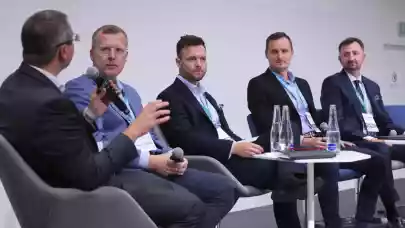
Rising borrowing costs and a more uncertain economic outlook have undoubtedly changed the way real estate projects are financed, but market participants suggested that access to debt remains relatively healthy for the right opportunities. The focus has shifted from chasing growth to assessing resilience, with lenders placing greater emphasis on cash flow, sector fundamentals and sponsor quality. These themes dominated the financing discussion at Prague Property Forum 2026.
Chairing the discussion, Pavel Krchňák MRICS, Head of Real Estate Valuation at Oberbank, framed the debate around whether financing conditions are truly tightening or whether perception has run ahead of reality. He pushed lenders and developers to spell out where the real pain points lie, from DSCR and LTV to pre‑sales and refinancing in a potentially higher‑for‑longer rate environment.
From the developer side, Jakub Korf, Group CFO of Trigema, stressed that financing challenges vary sharply between build‑to‑sell and build‑to‑rent projects. In for‑sale residential schemes, pre‑sales become the critical constraint in weaker cycles, especially now that mortgage rates above 5% dampen buyer appetite, whereas in build‑to‑rent it is DSCR and cash‑flow robustness that really determine bankability. He outlined Trigema’s funding mix of equity, project finance, investment loans and long‑standing bond issues, but underlined that banks remain the most scalable and strategically central funding source. Given the company’s focus on high‑end projects in Prague and other major cities only, he argued that moving into smaller regional markets simply does not stack up economically.
Representing a regional lender’s perspective, Roman Kubányi, Director for International Commercial Real Estate Clients at Erste Group Bank AG, acknowledged that banks now operate under heavier regulation and must factor in ESG and geopolitical risk more systematically. However, he argued that Erste’s core credit stance has not fundamentally tightened for strong sponsors and sound projects, pointing out that CEE still enjoys a favourable spread between relatively low all‑in debt costs and higher yields compared to Western Europe. Kubányi emphasised that sector appetite is increasingly country‑specific: offices can still work in Warsaw but look far less attractive in Bratislava, while logistics in under‑supplied markets like Romania or Serbia continues to offer compelling absorption. Looking ahead, he highlighted rising activity around defense‑related storage and light industrial facilities, especially in Poland, as well as the fast‑emerging opportunity in data centres, which will hinge on securing sufficient power and grid capacity.
On the industrial and logistics side, Tomáš Procházka, CFO of Accolade, described how the company’s footprint across Poland, the Czech Republic and several Western European markets is benefiting from long‑running trends like near‑shoring and friend‑shoring. He noted that corporate and EU‑level pressure to secure multiple suppliers for critical components is driving investment into more resilient supply chains, which in turn requires extra warehousing and light industrial space. Procházka pointed to large‑scale infrastructure projects, such as the planned new central airport and high‑speed rail lines in Poland, as catalysts that will further enhance the region’s logistics appeal. On the risk side, he framed vacancy as a natural feature of any mature portfolio and argued that both sponsors and banks increasingly manage performance and covenants on a portfolio basis rather than asset by asset, which makes the model more resilient.
Offering a domestic banking view, Jiří Vančura, Director of Real Estate and Corporate Finance at Trinity Bank, painted a relatively positive picture of credit availability in the Czech Republic for projects with strong sponsors and prime locations. He explained that while Trinity finances all major real estate sectors, it is highly selective, with a clear bias toward Prague, Brno and regional capitals, and toward top‑tier schemes in those markets. In both development and long‑term investment loans, he said that DSCR, cash‑flow stability and appropriate maturities now matter more than headline LTVs, and that rent growth in recent years often compensates for higher interest costs at refinancing. Vančura reported strong bank appetite and competition in the first months of the year and expects this to intensify further in the second half, especially as larger institutions approach their annual lending limits and more opportunities open up for agile players.