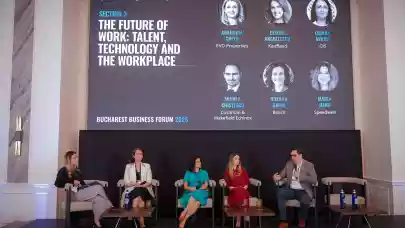
The workplace is being redefined by far more than hybrid working. As businesses adapt to AI, changing employee expectations and growing ESG ambitions, the office is evolving into a strategic tool for attracting talent, strengthening culture and improving performance. These themes were at the centre of the workplace panel at Bucharest Business Forum 2026, where experts agreed that successful workplaces are no longer measured by efficiency alone, but by the experience they create for employees.
As chair, Anamaria Cretu, Leasing & Asset Director at EVO Properties, framed the discussion around the profound transformation of work in recent years, from heightened competition for talent to shifting employee expectations and the rise of AI. She underlined that offices are no longer built primarily for efficiency and cost, but increasingly for community, experience, and well-being, drawing on examples from EVO Properties’ projects. Throughout the debate, she steered the conversation between corporate HR, landlords, and workplace strategists to show how real estate decisions have become a core part of talent strategy, not just an operational cost.
Liliana Avram, HR Head for Romania and Bulgaria at Citi, argued that flexibility has become a baseline expectation rather than a perk, especially in highly regulated sectors like banking. She emphasised autonomy and trust as the real essence of flexible work, with employees needing control over when and where they work. Liliana also highlighted how AI and data are pushing HR away from intuition-led decisions toward more predictive, metrics-driven approaches, making employer branding more authentic and less about glossy promises that new generations quickly see through. For her, psychological safety, inclusive leadership, and a culture of continuous learning and reverse mentoring will define which organisations retain talent in the long term.
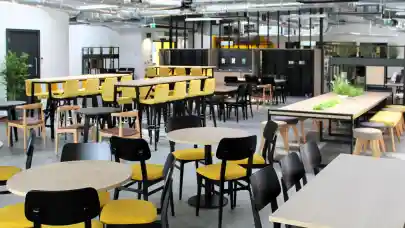
From an operational and infrastructure standpoint, Roxana Daian, Cluster Lead Facility and Construction Management for Romania & Bulgaria at Bosch, described how the company anticipated hybrid work even before the pandemic. Bosch implemented shared-desk concepts, dynamic lockers, and a rich mix of collaboration areas, focus zones, and social spaces, complemented by on-site gyms, restaurants, and other amenities. She detailed how smart building technologies and AI-driven systems now track real-time occupancy to adjust cleaning, ventilation, and temperature, significantly optimising energy use in a portfolio that is a major power consumer. Roxana stressed that, because employees voluntarily exceed their contractual office days, these investments clearly translate into stronger connection to the company and sustained office use.
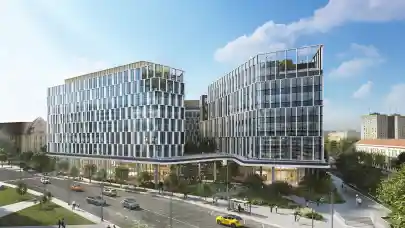
Representing the developer and landlord side, Maria Jianu, Leasing Director at Speedwell, explained how occupiers’ approach to office space has become more conservative yet more sophisticated. Companies tend to take less space than their full headcount would imply, banking on hybrid work and hot-desking while redesigning floors into distinct collaboration, focus, and active areas. She noted a marked “flight to quality,” where quality is defined less by luxury finishes and more by a rich ecosystem of amenities—such as convenience retail, restaurants, fitness, beauty, and speciality coffee—that make the office a better experience than home. Maria also outlined how pre-development decisions, building infrastructure and flexibility, and carefully curated ground-floor retail are now central to both leasing strategy and long-term asset positioning.
Mihnea Cristescu, Project Manager & Sustainability Consultant at Cushman & Wakefield Echinox, placed ESG at the heart of workplace strategy, arguing that the “S” (social) dimension is where much of the real value lies. He stressed that successful strategies must be built by engaging leadership, middle management, and staff, who often hold differing views that need to be aligned into a coherent vision. On the environmental and technological side, he pointed to the importance of adaptable building design, multi-functional spaces, and governance structures that clearly define who “owns” the workplace inside organisations. Mihnea cautioned that true workplace strategy is not a quick fix but a multi-month process of analysis, dialogue, and planning—still seen as a luxury by many firms, yet a decisive differentiator for those planning seriously for constant change.