Investment activity in Slovakia is showing clear signs of recovery, supported by improving sentiment and renewed capital flows across Europe. We report from Bratislava Property Forum 2026.
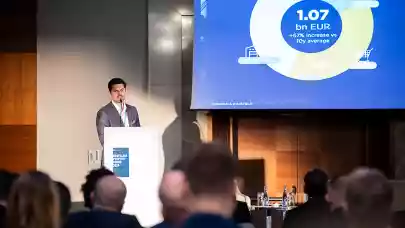
In his opening presentation, Rudolf Nemec, Partner & Head of Capital Markets Slovakia at Cushman & Wakefield, highlighted that while recent years have been marked by volatility, the market is now approaching an inflexion point, with both domestic and international investors gradually returning.
Over the 2015–2025 period, a total of €7.5 billion was transacted in Slovakia, with a 10-year annual average of €645 million. Activity picked up again in 2025, reaching €1.07 billion, significantly above the long-term average. This rebound reflects improving financing conditions and a more positive outlook among investors.
The Slovak market remains strongly influenced by international capital. Foreign institutional investors accounted for 45% of total volumes in 2025, with capital coming primarily from Czechia, Western Europe and other CEE countries. At the same time, domestic and regional players continue to play an important role, particularly in smaller or value-add transactions.
Looking at asset classes, industrial and retail dominated activity, accounting for 43% and 40% of total investment respectively, while offices represented a smaller share. This reflects broader regional trends, where logistics and retail parks remain attractive due to stable income profiles, while the office sector continues to adjust to changing occupier needs.
Major transactions in 2025 underline continued investor interest in large-scale assets and portfolios. Deals included retail, office and industrial properties in Bratislava, with ticket sizes ranging from €50 million to €180 million.
From a broader perspective, CEE investment volumes reached €11.76 billion in 2025, around 9% above the 10-year average, signalling a wider regional recovery. Across Europe, total investment volumes stood at approximately $220 billion, with domestic capital accounting for the majority of activity, followed by global and pan-European investors.
Nemec noted that market sentiment has reached its highest level since 2022, supported by increased capital raising and expectations of rising transaction volumes. The recovery is already underway, although it remains uneven and sensitive to external factors such as interest rates and geopolitical developments.
At the sector level, occupier behaviour continues to shape investment strategies. Office demand is stabilising, with tenants focusing on prime locations and high-quality buildings. In industrial, decision-making has slowed due to ongoing uncertainty, creating a tenant-friendly environment. Retail, meanwhile, remains resilient across much of Europe, although Slovakia has yet to see strong rental growth.
Despite the improving outlook, investors remain cautious. Key risks include inflation, energy pricing, interest rate volatility and geopolitical tensions, all of which continue to influence pricing and risk appetite.
Looking ahead, the European real estate market is expected to recover further over the next three years, although progress may be gradual. Liquidity and occupational growth are likely to be the main drivers of activity, while investors remain selective in their allocations.
Overall, the Slovak market appears to be entering a new phase, where improving fundamentals and stronger sentiment are beginning to translate into renewed investment activity.