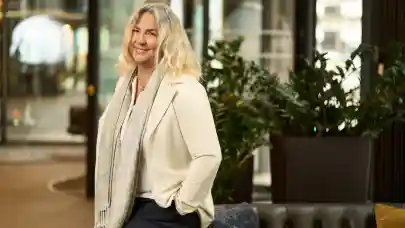
As housing affordability remains a major challenge in Poland, professionally managed rental housing is becoming a more established part of the residential market. Elżbieta Chmiel, Member of the Management Board of PFR Nieruchomości, discusses changing attitudes towards renting, demand beyond Poland’s largest cities, the company’s investment pipeline and what is needed to make long-term renting a genuine alternative to homeownership.
This interview was originally published in our POLAND TOP 50 publication, listing the 50 most influential people in Polish real estate.
Housing affordability has become one of the biggest challenges facing the Polish market. What role can professionally managed rental housing realistically play in addressing this problem?
Professionally managed rental housing cannot solve Poland’s housing affordability challenge on its own, but it can provide an important additional option. Not everyone wants or is able to buy a home, particularly at a time when high property prices and financing costs make ownership less accessible. Institutional rental offers flexibility without requiring a long-term mortgage commitment, while providing predictable terms and professional service. It also adds quality and choice to the housing market. In our view, ownership and renting should not be treated as competing models, but as complementary solutions responding to different needs and stages of life.
PFR Nieruchomości recently brought its rental portfolio together under the new naj m® brand. Why is now the right moment for this change, and what does it say about how the Polish rental market is maturing?
The Polish rental market has changed significantly since we launched our first project in 2015. Tenants today are more aware of their needs and have higher expectations. Our participation in the Living 2040 report confirmed that the definition of a good home is changing: alongside price and location, people increasingly value functionality, predictable costs, access to green spaces, peace and the quality of the surrounding environment. The report also points to a growing acceptance of long-term, professionally managed rental as a conscious choice rather than simply a temporary stage before buying a home.
We see this change in our own portfolio as well. The average age of our tenants is around 45, which shows that institutional rental is no longer a solution associated mainly with students or people starting their careers. It increasingly responds to the needs of people at different stages of life.
The introduction of naj m® is a response to this maturing market. We wanted to make our offer clearer and provide a more consistent experience, from finding an apartment to everyday contact with the operator. For us, the brand is not an end in itself, but a way of responding to changing expectations and the growing importance of quality and professionalism in rental housing.
Your portfolio now covers both major metropolitan markets and smaller cities such as Skawina, Elbląg and Sochaczew. What have you learned about demand for institutional rental housing outside Poland’s largest cities?
Our experience shows that the need for good-quality rental housing is not limited to the largest metropolitan areas. Demand is closely linked to local conditions: employment opportunities, transport connections, universities, population trends and the availability and affordability of alternative housing. Smaller cities can offer particularly interesting opportunities when a project responds to a clearly identified local need. Our portfolio allows us to observe these differences and adapt the scale and character of projects to individual markets rather than applying one model everywhere.
With occupancy across the portfolio above 98%, where do you see the greatest potential to expand the rental offer further, and what determines whether a city or project is suitable for investment?
High occupancy confirms that there is strong demand for professionally managed rental housing, but it is not the only factor we consider. We look at the local labour market, demographics, population trends, transport, access to services and the availability and affordability of alternative housing. The economics of each project are equally important.
Our current investment pipeline reflects this approach. This year, we are completing two projects in Wrocław, with 477 and 414 apartments. We are also delivering a 200-apartment project in Sochaczew and a smaller 50-apartment project in Warsaw, while construction is underway on around 400 apartments in Szczecin. This mix shows that we see opportunities both in major metropolitan markets and in smaller cities.
Our experience confirms that demand for institutional rental housing is not limited to Poland’s largest urban centres. What matters is whether a location has sustainable long-term demand and whether the project can respond to the specific needs of its residents. We therefore assess each market individually rather than applying a single investment model across Poland.
PFR Nieruchomości can develop projects, cooperate with municipalities and acquire completed residential schemes from private developers. In the current market, which of these routes offers the most interesting opportunities for growing the portfolio?
We do not see one route as universally better than the others. Each offers different opportunities, and the most important question is whether a project makes sense in the long term. This means looking beyond the location itself. A good residential project should be well connected to the city but also offer a well-designed and welcoming environment for its residents.
Our project in Katowice is a good example. It comprises 523 apartments, but they are distributed across 26 low-rise buildings, creating a more intimate character despite the scale of the development. The layout of the buildings also creates neighbourhood spaces, while extensive greenery is an important part of the project. This is an approach we increasingly see as essential: density and scale do not have to come at the expense of quality or a sense of community.
We also believe that a residential investment can contribute to the wider urban environment. In Wrocław, at our Kolejowa project, we are working with BWA Wrocław on an artistic installation located on historic buildings that form part of the development. It is an example of how a residential project can engage with the identity and cultural fabric of the city.
So whether we develop a project ourselves, work with a municipality or acquire a completed scheme, we look at the whole picture – not only how many apartments can be delivered, but also what kind of place they will create and how it will become part of the city.
Poland remains a strongly ownership-oriented housing market, but attitudes towards renting are evolving. What would need to change for long-term renting to become a more established alternative to home ownership?
The biggest change is already taking place: renting is gradually becoming more professional and predictable. For long-term renting to become a more established alternative, tenants need a sufficiently broad supply of good-quality homes, transparent terms and confidence that renting can provide stability. The market also needs to move away from the idea that renting is only a temporary step before buying. Ownership will remain an important aspiration in Poland, but a mature housing market should offer people a genuine choice between owning and renting, depending on their circumstances and stage of life.