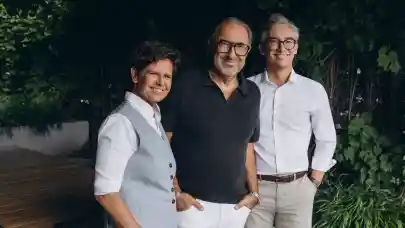
Capital Park is entering a new phase of growth, combining complex urban regeneration with an increasingly important residential component and active management of established assets. Kinga Nowakowska, Marcin Juszczyk and Jan Motz discuss the evolution of Norblin Factory, the next steps for Nowy Wełnowiec, investor appetite for prime Polish real estate and why the Group sees value in projects where complexity and placemaking create opportunities.
This interview was originally published in our POLAND TOP 50 publication, listing the 50 most influential people in Polish real estate.
Norblin Factory is celebrating five years since its reopening following one of Warsaw’s most complex regeneration projects. Looking back at these five years, how has the project evolved, and what have you learned about creating and operating a mixed-use destination of this scale?
Kinga Nowakowska: The biggest lesson is that a mixed-use project is never really finished. Five years after opening, Norblin Factory is fully commercialised, attracts around half a million visitors every month and continues to evolve. Success, however, is not simply about footfall. Offices, gastronomy, retail, culture, entertainment and services need to complement one another and keep the destination active throughout the day and week. This requires active management – constantly observing how people use the place, adjusting the tenant and concept mix and introducing new experiences. Norblin Factory has taught us that successful mixed-use is as much about operations as development. The buildings may be complete, but the destination itself must keep evolving.
The sale of Royal Wilanów for more than €100 million marked the completion of a major investment cycle for Capital Park, while you remain involved in managing the property. What does the transaction tell you about investor appetite for high-quality, established assets in Poland today?
Marcin Juszczyk: It demonstrates that there is capital for the right product. Investors remain selective, but high-quality assets in strong locations, with established tenant bases and proven performance, continue to attract interest. Royal Wilanów had reached a mature stage in its investment cycle, and the transaction confirmed the value built into the asset over the years. We also continue to manage the property, reflecting the importance of asset management in our business model and our belief that value creation continues long after development is completed. More broadly, the transaction confirms that there is liquidity for prime, well-performing assets in Poland when the fundamentals and pricing expectations are aligned.
Nowy Wełnowiec has moved closer to implementation, with public consultations completed and the selection of a general contractor for the first phase underway. What are the key priorities as you move from planning a 30-hectare urban district to actually delivering its first buildings?
Kinga Nowakowska: The challenge now is to translate a very ambitious masterplan into a first phase that already establishes the quality and character of the future district. With a 30-hectare project developed over many years, you cannot wait until the final phase for the place to start working. That is why the first central, seven-hectare area is so important. The first stage will include three residential buildings with more than 230 apartments, together with the necessary infrastructure and the restoration of the historic Compressor House – the only surviving building from the former industrial complex. We are currently selecting the general contractor and intend to complete this process by the end of 2026. At the same time, we have just completed more than a year of public consultations involving residents, community organisations, local authorities, experts and potential future users. This was valuable because ultimately we are not delivering an isolated residential scheme, but a new piece of Katowice. The entire project will combine housing with services, retail, gastronomy and leisure, with around 10 hectares of greenery and recreational space. Getting the first phase right is therefore critical to everything that follows.
Capital Park is increasingly focusing on complex urban regeneration, from the former industrial site of Nowy Wełnowiec to the historic Rezydencja Aleja Fontann in Szczecin. What makes regeneration projects particularly attractive to you compared with conventional development opportunities?
Jan Motz: Complexity can be a barrier, but it can also be where value is created. We are attracted to projects where the solution is not obvious and where development expertise, investment experience and a long-term perspective can fundamentally change the potential of an asset or location. Regeneration also gives us something that conventional development often cannot: an existing identity. In Szczecin, we are working with a historic 19th-century building in an exceptional city-centre location. In Nowy Wełnowiec, we are transforming a large post-industrial area and preserving the one historic building that remains on the site. These projects are completely different in scale, but in both cases the history of the place becomes an asset rather than an obstacle. Of course, regeneration carries additional complexity and risk. But if you manage those risks properly, you can create a product that is difficult to replicate. That is particularly interesting to us.
Residential will account for the largest share of Nowy Wełnowiec, while you are also developing 62 premium apartments in Szczecin. How important is residential becoming within Capital Park’s broader business strategy?
Marcin Juszczyk: Residential is becoming an important part of our development activity, but we do not see it as a standalone volume business. We are not pursuing scale for its own sake. For us, housing is particularly compelling when it forms part of a broader urban strategy. In Nowy Wełnowiec, it is the dominant use, but it will coexist with retail, services, leisure and extensive public and green spaces. In Szczecin, residential is the function that allows us to give a historic building a new life while creating a premium product appropriate for its location. So our approach remains selective. We are interested in residential where we can bring something beyond simply delivering apartments – whether that is regeneration, mixed-use expertise, placemaking or a particularly distinctive asset.
Capital Park has undergone a significant transformation following the management buyout and is now pursuing a new generation of development and regeneration projects. How has this changed the way you make investment decisions, and what are your ambitions for Capital Park over the next few years?
Jan Motz: What has not changed is our entrepreneurial approach. We are not interested in growth simply for the sake of adding square metres. We are selective and look for projects where our expertise can unlock value that is not immediately visible. We are comfortable with complexity when it comes with the potential to create something distinctive and commercially strong. That is where I see Capital Park’s role: not necessarily being the largest player, but being one of the most capable when a project requires vision, patience and the ability to manage complexity.