A boom in the cards for Croatia’s residential market

16
Oct
2017
News - A boom in the cards for Croatia’s residential market #Bulgaria #CEE #Croatia #Czech Republic #housing #Hungary #price #report #residential #SEE

by Import Sys | Residential

Residential markets are on the rise all over Europe. There are barely any countries where prices haven’t begun to increase since the crisis. Property Forum took a closer look at the Central and Eastern European region, to see which countries have seen the highest growth. Croatia is one of the countries where prices began to grow later rather than sooner, but this means that it may become a new hotspot for investors looking to profit from house price growth in the region.


Hungary: no need to worry
 
Hungary has no need to be ashamed, for in terms of growth, prices have gone up by over 35 percent since they bottomed out in 2015. Residential property in the country is now 11 percent more expensive than it was before the crisis.
 
Even though the pace of growth has decreased, Hungary ranked fourth among EU members in house price growth last year. The residential market is still booming: homes were 8 percent more expensive in the first quarter of 2017 than they were in the same period of 2016. Many have feared that the inflated prices will result in the formation of a bubble on the housing market, but the European Systemic Risk Board has issued no formal warning to date. The National Bank of Hungary is also closely monitoring price dynamics and has stated that it is ready to intervene should a risk of significant vulnerability arise.
 
Czech Republic: in motion
 
The Czech Republic’s residential market is also growing steadily. Although prices “only” grew by 24 percent compared to the bottom of the cycle (i.e. much less than in Hungary), the fall-back caused by the crisis was also less significant. Prices on average are now 13 percent higher than they were before the crisis. Favourable credit conditions, strong economic growth and increasing real wages also help fuel the growth of the residential market. In Q1 2017 the Czech Republic posted the strongest year-on-year price increase within the EU with a figure of 13 percent.
 
Bulgaria: still room for growth
 
The Bulgarian residential market has also started to present stronger figures. The first three months of 2017 saw prices increase by 8.8 percent on a yearly basis, which is significantly stronger than the figures of previous quarters. Average prices, however, are still nowhere near the pre-crisis high. Homes today are nearly 27 percent cheaper than they were in 2008.
 
Croatia: finally picking up
 
Even though residential markets in Central and Eastern Europe have high price increases on average, there are significant differences between the countries. In contrast to most countries mentioned above, Poland, Slovenia and Croatia have posted weaker figures: prices are currently less than 10 percent higher than they were before the crisis. In two of them, however, the pace of growth picked up in Q1 2017. In Poland prices grew by 3.3 percent on a yearly basis, which implies a stronger growth than the 0.9 percent rate of Q1 2016. And in Slovenia, prices grew by 5.9 percent in Q1 2017 compared to the 0.8 percent posted in the first quarter of last year.
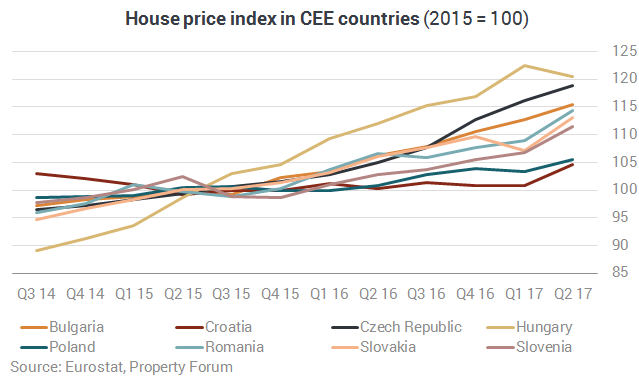
Among the countries of Central and Eastern Europe, homeowners of Croatia have the least to be happy about. The falling of prices seems to have stopped but growth is still fragile. Between Q1 2016 and Q2 2017 quarters of positive and negative growth have both been recorded. The future, however, looks bright for Croatia. Transaction numbers have also begun to rise which further confirms that the Croatian residential market is at the doorstep of a major boom. This means that the country can become a new hotspot for investors looking to profit from house price growth in the region.
 
The coastal regions of Croatia have performed best; at least, that is where the largest increase in prices was registered. According to data collected by the Global Property Guide, prices grew most significantly (by 4.2 percent year-on-year in 2016) in Sibenik-Knin Couny. Istria County took the second place with a yearly increase of 3.1 percent. The city where prices rose the most was Split, and the city with the most expensive homes was Dubrovnik, where the average property price reached €3349 per square metre.

The full version of this article has been published in the latest issue of Portfolio Property Magazine.




Latest news


New leases

  • A new KIKO MILANO store has opened at the Nový Smíchov shopping centre in Prague, as part of a lease transaction brokered by Cushman & Wakefield.
  • Kenneth Cole New York has launched its European debut with a 200 sqm store in Prague’s Westfield Chodov shopping centre.
  • Galeria Askana in Gorzów Wielkopolski has significantly bolstered its retail mix by signing a lease agreement with HalfPrice for a unit exceeding 2,000 sqm. The off-price retailer, part of Grupa Modivo, is scheduled to open its doors at the end of August 2026. The project features a large-format layout with the potential to expand the footprint to nearly 2,700 sqm.

New appointments

  • Romanian office developer Genesis Property has appointed Cătălin Niculiță as Leasing Manager. With nearly 20 years of experience in the real estate industry, he has held leadership roles at real estate companies such as Atenor, collaborating with major office tenants in the banking, telecom, and IT sectors.
  • Krzysztof Wróblewski (MRICS) has been named Head of Portfolio Management CEE at Peakside Capital Advisors, responsible for overseeing investments and managing the real estate portfolio. He succeeds Christopher Smith in this role.
  • Garbe Industrial is reorganising its senior leadership team. CEO Christopher Garbe will now focus on strategic orientation and international activities. Jan Philipp Daun assumes leadership of the Development division alongside his existing Investment and Joint Venture responsibilities. Andrea Agrusow expands her remit to include Portfolio Management while retaining control of Commercial and Real Estate Management. Additionally, Michael Marcinek and Maik Zeranski will now jointly head the restructured Development unit as Management Board Members, succeeding Adrian Zellner.


Latest news

News - Romania’s housing completions dip 3.1% in 2025
12
Mar
2026

Romania’s housing completions dip 3.1% in 2025

by Property Forum
Romania’s residential construction sector recorded a 3.1% contraction in 2025 compared to the previous year. The total number of completed dwellings reached 59,062, marking a decrease of 1,916 units from the 60,978 reported in 2024, according to provisional data provided by the National Institute of Statistics (INS).
Read more >
News - AFI Arad achieves LEED Gold for all four retail buildings
12
Mar
2026

AFI Arad achieves LEED Gold for all four retail buildings

by Property Forum
AFI Romania has announced that all four buildings within the AFI Arad retail park have achieved LEED Gold certification. The certified buildings include AFI Arad Strip Mall, AFI Arad McDonald's, AFI Arad Leroy Merlin and AFI Arad Shopping Gallery.
Read more >
News - One United Properties enters US market with Nashville land buy
12
Mar
2026

One United Properties enters US market with Nashville land buy

by Property Forum
Romanian developer One United Properties has announced its Board of Directors approved a strategic framework for phased entry into the US residential real estate market, by completing its first land acquisition in the Nashville metropolitan area.
Read more >


Property Forum ABOUT US

Property Forum is a leading event hub in the CEE real estate industry with over 10 years of experience. We organise conferences, business breakfasts and workshops focused on real estate, in London, Vienna, Warsaw, Budapest, Bucharest, Bratislava, Prague, Zagreb and Sofia, amongst other locations.
Please send press releases to
newsdesk AT property-forum DOT eu
MORE >

CONTACT

NEWSLETTER


Property Forum © 2017 – 2026 | Terms & conditions | Privacy policy