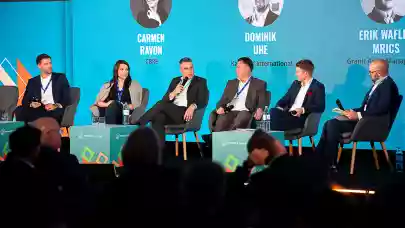
As liquidity gradually returns and pricing expectations realign, investors across CEE are reassessing where resilient income and long-term value can still be found. A session at CEE Property Forum 2025, moderated by James Fitzgerald, Director and Head of Industrial Agency at iO Partners, offered deep insights into how market dynamics have shifted over the past 18 months and what opportunities lie ahead as investors increasingly seek resilient, high-yielding assets.
Opening the panel, Fitzgerald underscored the unique challenges and opportunities facing the sector. “The last 18 months have been a rapid period of repricing and shifting demand across all three sectors, with capital that had paused now starting to look for opportunities in 2025,” Fitzgerald explained, drawing attention to the liquidity slowly re-entering the market. He emphasised, “What I did learn through my experience is that leasing is the lifeblood of development — without occupiers and robust leasing, there simply is no successful development.” Fitzgerald encouraged participants to scrutinise yield variations across markets, urging, “Prepare your questions, because we’ll make sure there’s time to really get to the heart of where the opportunities are emerging.”
Carmen Ravon, Head of Retail Occupiers CEE at CBRE, provided a detailed perspective on the evolution of retail demand and the crucial role of tenant mix in driving value. She observed, “In CEE, investors evaluating retail consider the city yield and asset quality, but above all, it’s the tenant mix that determines success. The question is always: How can we enhance the mix to maximise upside potential and drive rental revenue?” Ravon noted significant international interest, adding, “Across our region this year, we’ve seen about 70 new retail brands enter the market. Each country is attracting renowned names—whether it is Action and Wendy in Romania, Victoria’s Secret and Müller in Slovakia, or Rituals with its major pipeline in Hungary. The marketplace is vibrant, supported by nearly zero vacancy in retail parks and regional centres.” She also highlighted sector shifts, saying, “Health, beauty, and services are thriving, while sport operators have slowed post-pandemic and cinemas face uncertain futures as anchors in major centres. Nevertheless, the enduring appeal of well-managed shopping centres continues, as seen in transactions like Palladium in Prague.”
Turning to development and asset strategy, Dominik Uhe, Head of Investor Relationship Management at Kaufland International, spoke on retail’s adaptive edge. He remarked, “Our focus has been on designing retail and mixed-use sites that anchor grocers with specialist stores, creating a one-stop shopping experience that consistently proves resilient. In countries like Poland and Germany, this model is a standout, allowing us to flex formats based on local market needs. The key is understanding that proximity and thoughtful tenant combinations are what create enduring value and appeal.” Uhe further expanded, “It is not simply about building bigger, but smarter—integrating pharmacies and convenience into our locations makes them indispensable for routine shopping trips, and this adaptability is our core strength as we look ahead.”
Paul Kusmierz, CEO of Master Management Group, shared his perspective on yields and the drivers behind the surge in regional retail park investment. “Just 18 months ago, some retail parks in Poland were yielding around 9.5 percent, fully leased with recognisable anchor tenants. Fast-forward to the present, and those same assets are trading at yields close to 7.5 to 8 percent, underscoring the explosion in demand and the robustness of the market,” he stated. Kusmierz connected this trend to consumer confidence, noting, “The underlying driver is clearly the consumer’s elevated spending power. Retail developers need to act boldly—the ones who have moved quickly have been able to capitalise on this robust, cyclical upswing and are now reaping substantial rewards.”
On the ESG front, Martin Polák, Managing Director CEE at GARBE Industrial Real Estate, tackled the nuanced impact of sustainability on asset values. Polák observed, “Achieving strong ESG certifications is no longer just an add-on, but a necessity for attracting capital and ensuring liquidity. While we’re not yet seeing clear premiums for ESG-aligned retail assets, investors and banks expect a certain standard; it’s the new baseline for quality and sustainability in our sector.” He added, “If you set your focus and energy on the geography and asset class where you have local knowledge and expertise, as I do with logistics, that’s where you maximise your chances at fair, sustainable pricing. Time and again, deals in logistics have demonstrated the resilience and long-term value of these assets, even now, when stock for sale is temporarily high, and prices are momentarily discounted.”
Erik Wafler MRICS, Senior Investment Manager at Gránit Asset Management, offered a pragmatic view of the market’s evolution and the shifting calculus of risk. “Yields have largely normalised post-pandemic, and while we saw a hiatus in transaction volumes, activity has rebounded as buyers and sellers realign expectations,” he explained. “When it comes to ESG, our investors won’t pay a significant premium for a LEED or BREEAM certification alone, but these features are compelling for tenants and vital for securing advantageous financing. Ultimately, our strategy is to diversify across markets—select high-quality assets in various countries, aiming for liquidity and portfolio resilience through careful selection rather than pure diversification by asset type.”
By the session’s end, the panellists agreed that while investment strategy is increasingly data-driven and risk-aware, the heart of property investment remains tied to an understanding of both macroeconomic dynamics and the subtleties of consumer behaviours.