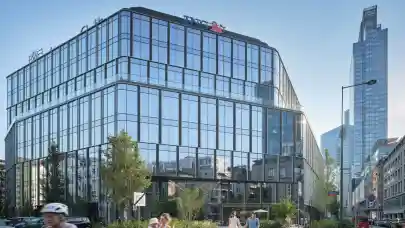
With occupier demand increasingly focused on prime, well-located buildings, Warsaw’s office market is becoming more selective. Around Rondo Daszyńskiego, one of the city’s most established business locations, this trend is particularly visible. The FORM is among the office assets benefiting from this shift: since opening in early 2025, it has become fully leased, attracted a diversified mix of public- and private-sector occupiers and demonstrated substantial day-to-day use. Its performance to date, combined with the continued evolution of the surrounding district, reinforces its position as a trophy office asset.
Poland entered 2026 with a clear acceleration in real estate investment activity. According to Colliers’ CEE Investment Scene H1 2026 report, commercial real estate investment volumes in Poland exceeded EUR 3 billion in the first six months of the year, the strongest first-half result since 2018. Across the CEE-6 region, offices attracted the largest share of capital at 29%. Colliers also highlights strong demand for prime, ESG-compliant and centrally located office buildings, with prime CBD vacancy falling sharply in Warsaw.
Rondo Daszyńskiego: established, accessible and still evolving
Rondo Daszyńskiego has become one of Warsaw’s key business locations, supported by metro, tram and bus connections, nearby rail services and a broad range of amenities. At the same time, the surrounding district continues to evolve, with more residential, service and dining uses strengthening its role beyond standard office hours.
The FORM benefits directly from this setting. Located within walking distance of the metro, it offers occupiers a central business address with strong public transport and an increasingly complete urban environment. Its tenant mix reflects the breadth of that appeal, bringing together NFOŚiGW, ING Hubs Poland, Colliers and international law firm Clyde & Co, alongside companies from the financial services and technology sectors.

A prime office asset built for flexibility
The FORM provides approximately 31,000 sqm of office and retail space across nine storeys. Floorplates range from approximately 2,900 to 4,000 sqm, while three independent vertical cores allow large floors to be subdivided between different occupiers, providing considerable flexibility in how the space is configured.
Its technical specification includes an advanced BMS, utility monitoring, smart access solutions and a mobile building application. The ventilation system provides fresh air with adiabatic humidification and high-efficiency filtration, while the HVAC system benefits from free cooling technology.
The building has achieved Platinum ratings under LEED, WELL, AirScore D&O, ActiveScore, WiredScore and SmartScore, alongside the Building Without Barriers certification. For investors comparing Warsaw with established Western European office markets, this places The FORM within a familiar institutional benchmark: strong ESG credentials, technical performance, flexibility and a high-quality user experience.
“The strongest validation of The FORM today is that the concept has already been tested by the market. The building is fully leased to a strong and diverse group of occupiers, it sits in one of Warsaw’s most established business locations, and the quality designed into the project is visible in everyday use. With new prime office supply in Warsaw increasingly limited, that combination of location, product quality and proven occupier demand is becoming difficult to replicate,” says Damian Grzywacz, Lincoln Property Company Poland.

Amenities tested in everyday use
The FORM combines its relatively compact scale with a broad range of user facilities. Cycling infrastructure includes 216 bicycle spaces, 240 lockers, ten showers, a repair station, dedicated cyclist access, a separate lift and charging facilities for electric bicycles and scooters. Three terraces on the fifth, sixth and eighth floors provide outdoor space and views across Warsaw, while a landscaped patio forms the centre of the building.
Building management also points to regular use of the mobile application for access and communication with occupants, while openable façade panels are among the features appreciated by users. On the ground floor, restaurants and other services extend activity beyond office hours. Coffeedesk brings a speciality coffee offering to the building, while the dining mix ranges from Wandal, recognised by the MICHELIN Guide with a Bib Gourmand, to Dřevný Kocůr, a more casual sports bar concept.
Proven performance after opening
Following its commercial opening in early 2025, The FORM welcomed its first tenants and is now fully leased. Its diversified tenant base spans public- and private-sector organisations, Polish and international companies and several different industries, reducing dependence on any single occupier profile.
The building is also seeing substantial daily use. According to building management, around 1,000 people work there on the busiest midweek days, with lower numbers on Mondays and Fridays reflecting hybrid working patterns. Its amenities, access systems, terraces and common areas are therefore being tested by real users every week.
The FORM has also demonstrated its ability to accommodate a large-scale workplace transformation. ING Hubs Poland used the move to consolidate two previous Warsaw locations into a single workplace, creating its Dream Space Warsaw concept.
“The move to The FORM allowed us to consolidate two Warsaw locations and bring employees together in one workplace. Space was only one part of the requirement. We needed a building that could support different ways of working, collaboration and a strong sense of community while giving us the flexibility to create our Dream Space Warsaw concept. The FORM gave us the framework to do that at scale,” says Magdalena Domagała, ING Hubs Poland.
Colliers is one of the companies that chose The FORM for its own Warsaw headquarters, giving the company a first-hand occupier perspective on the building, together with a broader investment overview.
“For investors, the combination of proven leasing performance resulting in long income underpinned by investment-grade tenants, rental uplift potential on reversion, best-in-class technical standards, strong ESG credentials and a prime location is becoming increasingly important as genuinely core and brand-new office product becomes harder to source,” says Piotr Mirowski, Colliers Poland.