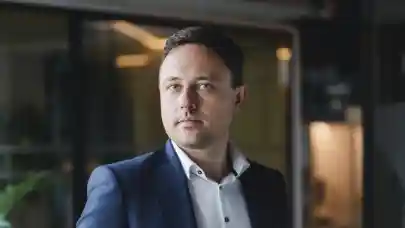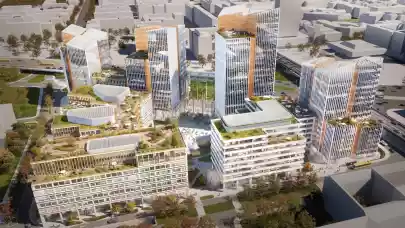
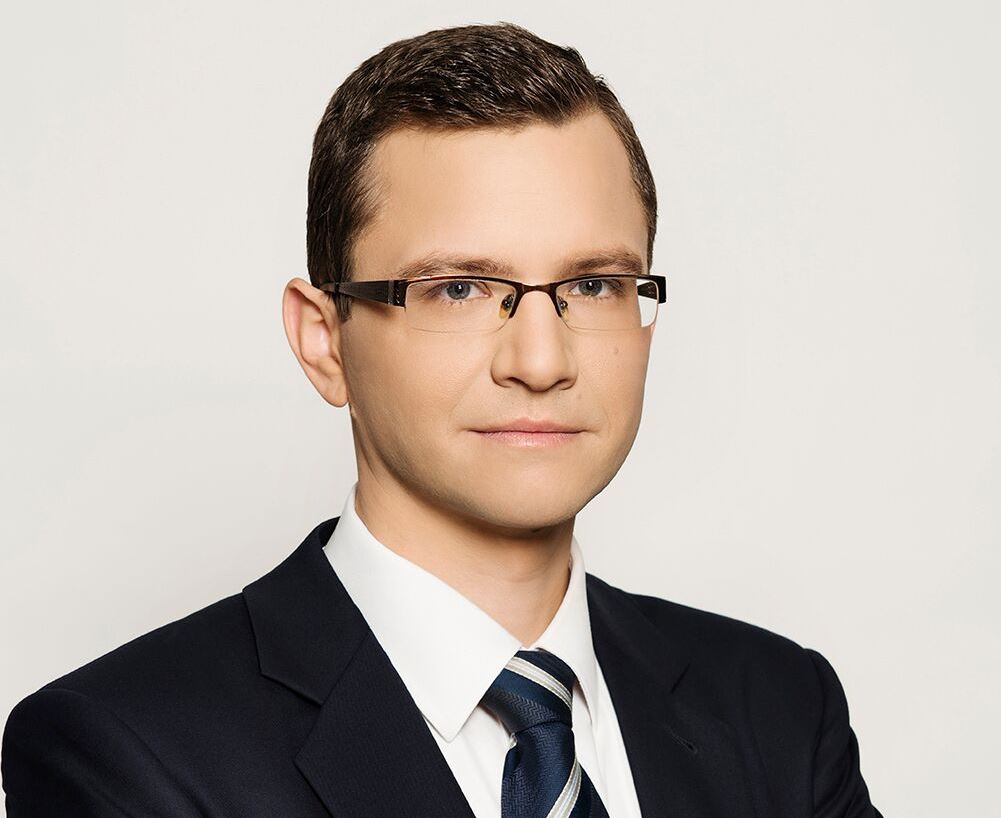
The recently appointed CEO of HB Reavis Hungary firmly believes that new office developments should focus on employee wellbeing and he thinks that tenants will be ready to pay higher rental fees for extra services that will help decrease their turnover. Jan Hübner talked to Property Forum about his expectations for the future of the Hungarian market and about Agora Budapest, the company’s major new development in the capital.
You’ve only been here in Hungary for a few weeks. How are you feeling?
I first came to Hungary 2 months ago to stay for a few days and attend a language course, then I spent a couple of days in Warsaw, then in Prague, so I spent most of my time on various means of transport. However, my family has now joined me in Budapest, and since September I’ve been officially working in the Budapest office. My family used to find our frequent moves from one country in the region to the other quite challenging, but my wife was actually quite happy that this time we were moving to Budapest. Besides, the people in the Budapest team are great, which further reassured me that coming to Hungary was a good decision.
Before coming here, what did you do at HB Reavis?
I’ve been working at HB Reavis for years and I’m as Central European as they come. I’m from the Czech Republic, I have a German name, I work for a Slovak company, where I spent 5 years at the Polish branch and now I’m moving to Hungary. At first, I worked as a site manager in Prague for 2 years. After that I moved to Poland where we set off with 6 people at the construction department and with 15 people altogether. After 5 years, having doubled our staff almost every year, there were 170 of us.
I’m sure that the vacancy rate will increase in the future and that the large number of developments will affect prices as well. The question is how we can deal with that. Trends are similar everywhere: there is growing competition for quality workforce, so in the long run you must offer benefits as well, not just money, to make employees choose your company. This is why we focus so much on sustainability, on providing a pleasant environment and available services. In addition, we are going to organise various programmes for our prospective partners, providing community events they can enjoy with their families as well. For example, if we open a restaurant, cookery courses can be held there, as an added value.
Have your received any feedback from prospective tenants? Are there tenants who have already committed themselves to the new office centre?
We are in negotiations with a number of potential tenants, large companies, and we are offering them what I mentioned earlier. They can also feel the problem of labour shortage. I think we can provide them with exactly what they need. Many large companies are interested in Budapest, so we are in a favourable position. Fortunately, besides Budapest, we are present in other countries as well, so we can test whether something that works for example in London, Poland or Slovakia will work in Budapest, and vice versa.
Many people, in Budapest as well, doubt that there is a demand for such extra services, as a significant number of companies are SSCs and for them the focus is on efficiency, not the work environment. What do you think about this?
It’s just natural, that different people have different opinions, time will tell. We have, for instance, a tenant at the Konstruktorska Business Center in Warsaw that entered the market very recently. They needed 6,000 sqm and emphasised that they are an SSC with a high staff turnover, but they would like to decrease the turnover rate by choosing an office where the employees feel better because of the greenery. We hope that other SSCs will also take this approach. Those times have passed when office development only meant the construction of the building.
Are tenants willing to pay higher rental fees for the extra services you mentioned?
At first, companies are not happy to pay more for anything, but then they realise that it might lead to some material benefits in the future, as people will work more effectively and turnover will be lower. In Warsaw, for example, the vacancy rate is twice as high as in Budapest, and there is demand for these services, so probably tenants will be willing to pay more in Budapest as well. We are continuously assessing needs.
You have mentioned that unemployment is low and labour shortage is an increasing problem in the whole region, even more so in construction. Does this lead to any problems with the Agora Budapest development?
We also care about the employees of the contractor. For example, in Poland, we provide adequate accommodation and meals to them. This is something we learnt in London, mostly, where contractors select assignments depending on the circumstances and working conditions of the given project. Now it is also true in this region, that if a developer cares about the contractors and provides proper working conditions, it can find a reliable one. The growth that we see now in the Central European region will not last forever, so it is worth thinking in the long term.
Are you working with one general contractor?
We coordinate the construction ourselves, but we are in contact with a lot of companies. We have very detailed plans on all development sites, and we procure the tools required for their implementation on a European level. Currently we are working on 300,000-400,000 sqm of development throughout Europe, so aligning processes also makes them more cost-effective. We have the construction company, we have the firm that is responsible for the interior spaces, but the process itself is managed by HB Reavis. Our procurement department plays a crucial role in this: 20+ people work here on group level. They put out tenders for various tools.
Are there enough resources here in Hungary or do you need workforce from Slovakia or Poland for example?
We are trying to carry out the tasks of the Budapest development with Hungarian workforce. Getting foreign workforce here is expensive anyway, but if need be, we will, of course, be open to that solution as well. Basically, however, we would like to work with Hungarian firms in Budapest.
How does the renovation of metro line 3 affect or influence the Agora project?
There are ongoing discussions with the authorities, they are familiar with our project, and we are also in contact with the locals. In this development for instance, we take care not to do the works that are very noisy during the night or at the weekend, rather during regular working hours. Despite all this, the construction can of course cause inconvenience to the locals, but in the long term, the new retail units on the ground floor, which will be open at weekends as well, the nicer environment, and the new services will be available for them as well.
The first investment of HB Reavis in Budapest was Váci Corner Offices. Here you had a financing model in which you started the development with your own capital, and at a certain stage, when pre-lease agreements had been signed, you used external bank financing. Is this the model you are using now?
Exactly, currently we are in negotiations with several banks. We use private capital up to a certain level, and then we use bank financing. This is the generally accepted development process we use throughout Europe.
Are you only planning office developments in Hungary?
The company develops offices and shopping centres, so in the future we might consider the latter in Hungary as well.
Is there any news about the future of the Bem Palace project?
There is no change there, we are having negotiations about the options and the necessary changes, but we can’t see the final direction yet.