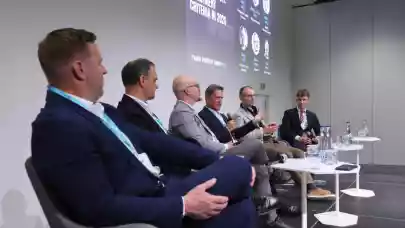
At Prague Property Forum 2026, the opening panel examined how investors are adapting their strategies in a volatile macro environment. Speakers highlighted that despite continued appetite for Czech real estate, higher financing costs, limited availability of quality assets, and growing uncertainty are pushing investors to become more selective, more cautious and increasingly focused on long-term resilience.
Moderator Tomáš Jandík, Founder of Crestpoint Capital Partners, structured the discussion around the full lifecycle of a transaction – from capital raising and market selection to underwriting, financing, portfolio construction and data strategy.
Representing the capital-raising perspective, Robert Kubín, Head of Distribution and Deputy Chairman of the Board at Amundi Czech Republic, underlined how unusual the Czech market is in a European and global context. Czech households allocate a far higher share of their portfolios to real estate than the European average, a pattern reinforced by strong cultural preference for tangible assets and years of inflows into residential property. This has supported the rapid growth of domestic real estate funds, with dozens of licensed managers collectively managing a sizeable pool of capital. However, Kubín stressed that this abundance of money chasing a limited pipeline of quality product makes acquisitions increasingly difficult and pushes pricing to levels that may not sustain historic returns around 7% per year, especially given higher financing costs and more attractive yields now available in other asset classes.
From the vantage point of a relatively young cross-border fund, Fraser Watson, Head of Real Estate at Axelor Group, provided a ground‑level view of competition and strategy. While acknowledging that the Czech Republic is a competitive market, he argued that well-prepared buyers still have a realistic chance of winning tenders in assets that fit their mandate, as typical bidding pools are not excessively crowded. For Axelor, the plan has always been to diversify internationally within a few years, leveraging the group’s presence in multiple European countries, local networks and service providers. He described their allocation approach as predominantly strategic, based on structured country and sector research, but with room to act opportunistically when rare, well‑located assets become available. On technology, Watson emphasised that data structuring and system design are being built with future AI tools in mind, but that for Axelor, technology is intended to support – not replace – the fundamentally relationship‑driven nature of real estate investment.
Marcel Kolesar MRICS, Transaction Manager at RSJ Investments, focused on how underwriting has evolved under heightened uncertainty, especially for development projects with multi‑year horizons. He noted that the core methodology has not radically changed over the past year, but scenario analysis has become deeper and more conservative, particularly around interest rate paths and financing conditions. RSJ is increasingly selective, prioritising projects with clear differentiating features that mitigate specific risks such as leasing or exit uncertainty, rather than standard, “plain vanilla” developments. Kolesar also described RSJ’s cautious but committed push to embed AI into analytics, dashboards and internal workflows. Progress has been gradual, he said, due both to the rapid evolution of AI tools and to the real estate sector’s general tendency to adopt technological innovation more slowly than other industries, which makes flexible, “AI‑agnostic” processes more valuable than any single tool.
Looking at financing as a practical constraint on deal flow, Ondřej Křivanec, Executive Director at Fidurock, argued that access to debt remains the decisive factor for many investors. He described recent years as a period in which long‑term planning is essential but frequently disrupted by unexpected macro and rate shocks, requiring sponsors to build more contingencies into their capital structures, including room for mezzanine solutions at refinancing if needed. Křivanec confirmed that sudden shifts in rates have already derailed otherwise advanced transactions when the economics no longer worked, and repricing could not be agreed with sellers. Nonetheless, he stressed that for high‑quality assets in favoured sectors such as retail parks and residential, banks remain willing to lend. For Fidurock’s own growth, he characterised continuous deal sourcing and execution as the core engine of the business, illustrating how the company has scaled from a mid‑sized urban transaction a few years ago to large‑scale residential development today.
Finally, Andreas Kozma, Founder & CEO of iREMS International AG, addressed the strategic importance of data and technology in an era of cross‑border expansion and growing portfolio complexity. He reported significantly increased interest from funds in using structured, high‑quality data to create a feedback loop between transactions and asset management, but argued that most organisations are still approaching the issue tactically – by layering systems and AI tools on top of spreadsheets – rather than redefining data as a managed, long‑term corporate asset. In his view, effective use of data and AI in investment decision‑making requires senior‑level commitment, clear governance, a consistent data model, and training of staff across the business, after which technology choices can be made more rationally. Kozma also cautioned that AI, while powerful in automating much of the heavy lifting in document processing and analysis, continues to require rigorous human oversight, particularly as more Czech capital moves into neighbouring markets such as Poland, where differences in language, regulation and market practice amplify the risks of incomplete or misinterpreted information.