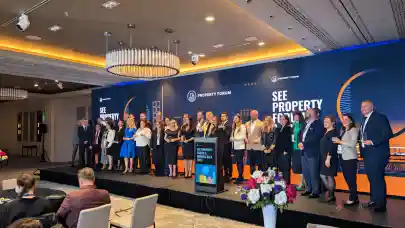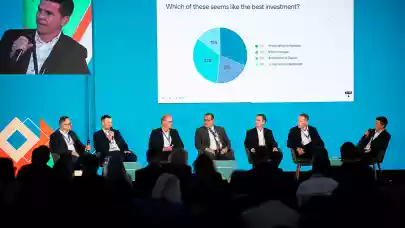
At CEE Property Forum 2025, local and cross-border investors came together in a panel moderated by Dániel Ódor MRICS, Partner at Taylor Wessing Hungary. The discussion offered not only a glimpse into current market sentiment but also probed the tides of regulatory evolution, sectoral dynamics, and strategic foresight driving CEE real estate forward.
Among the first to voice his investment preference, Kristóf Bárány, Founding Partner at Adventum International, underscored the strong case for retail parks, especially in Poland. “Retail parks in Silesia, and indeed the Polish market more broadly, represent compelling cash-flow opportunities and operational simplicity. We’re currently active with sizeable deals in this sector, and the sector’s appeal stands in stark contrast to just two years ago—retail has proven its cyclicality and its capacity for comeback.”
Tim Wilkinson MRICS, Head of European Acquisitions at Indotek Group, echoed the appeal of retail, while also reflecting on broader liquidity and international context. “From our perspective, retail remains an attractive proposition, but every acquisition boils down to price and exit strategy,” Wilkinson said. “We are heavily focused on returns and liquidity; whenever we consider CEE assets, the key question remains whether these markets can compete not just regionally, but also with opportunities across Western Europe.”
Bringing a different angle, Mirko Smiljanić, Managing Director at Grandum Property Management for Serbia and Romania, highlighted his confidence in the hotel and office market segments. “Our group’s experience with hotels in Hungary, and now major acquisitions in Bucharest and Bratislava as part of our expanding ‘5B’ strategy, affirms the enduring strength of top-quality assets,” Smiljanić emphasised. “For us, the winning formula is sustainability, high occupancy, and Pan-European balance, focusing on prime office buildings and certified green energy properties.”
As Head of Tax at Forvis Mazars in Romania, Edwin Warmerdam drew attention to the regulatory and tax complexities of mixed-use projects and the hurdles facing new fund structures in Eastern Europe. “Mixed-use redevelopment in city centres is crucial, not just for investors but for urban evolution,” Warmerdam remarked. “However, the viability of specific fund regimes like REITs depends on stable regulation, robust liquidity, and long-term trust in local markets—factors that remain inconsistently present in much of the region.”
Paulius Stulgaitis, Head of Investments at Eika Asset Management, highlighted pragmatic, sustained exposure to traditional asset categories. “We maintain a conservative posture, investing primarily in standard asset classes such as offices, retail, and logistics, with Poland offering prime opportunities,” Stulgaitis explained. “The CE region rewards deep market knowledge and patient capital, especially for investors seeking strong double-digit returns and the flexibility to diversify into mixed-use properties.”
Representing the agency side, Grzegorz Chmielak, Head of Valuation & Capital Markets at Axi Immo Group, called attention to Poland’s dynamic market fundamentals. “Warsaw boasts significant supply gaps and notable rental growth; investors in office space and retail parks are benefiting from healthy cash flows driven by strong consumer spending,” Chmielak said. “Nevertheless, the market’s future hinges on bridging the divide between international and local capital, as well as cultivating a new generation of experienced asset managers within Poland.”