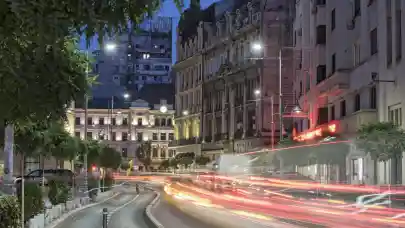
The number of passenger cars in Hungary has nearly doubled over the past 20 years, yet road networks and parking capacity have not kept pace. In Budapest, paid parking zones have continued to expand and fees rose sharply this summer, increasing the value of private parking spaces. According to an analysis by property portal zenga.hu, owning a garage or parking space has become a significant property asset rather than merely a convenience.
Zenga.hu data show that the average asking price for a garage in Budapest rose from 7.9 million forints to 8.5 million forints over one year. The most expensive locations are the inner-city districts, where asking prices can exceed 20 million forints when a space occasionally comes to market. "The most expensive areas are Budapest's first and fifth districts, where, if a garage rarely appears on the market, the asking price can exceed 20 million forints," said Péter Futó, head of analysis at zenga.hu. Garage prices generally track local residential values, with the per-sqm price of a parking space running at roughly half that of nearby flats, a pattern that holds for new developments as well.
Within Budapest, the second district commands an average of 16.1 million forints, the sixth district averages 15.1 million forints and the seventh district 12.7 million forints. Outer districts are considerably cheaper, with spaces in Csepel available from around 5.2 million forints. Average garage size in the capital is 13 sqm, compared with 17 to 18 sqm in provincial cities. In Debrecen and Szeged, average garage prices have reached 11.2 million and 11.1 million forints respectively, while most county seats see prices of between 7 and 9 million forints.
While sale prices have climbed, rental rates have remained more stable. In the most expensive Budapest districts, a space in a multi-storey garage typically fetches 50,000 to 60,000 forints per month, with the city-wide average around 30,000 forints. This means the rental yield from a garage is no longer higher than that achievable from a residential flat. "Renting out a garage does have one important advantage: unlike a flat, a parking space barely depreciates, maintenance is simpler and changing tenants involves far less administration," Futó added.
Experts say resolving Budapest's parking shortage would require additional park-and-ride facilities, multi-storey car parks and further public transport investment, coordinated with residential parking schemes. Because this represents a complex, long-term undertaking, properties with their own garage or surface parking space are expected to continue gaining in value.