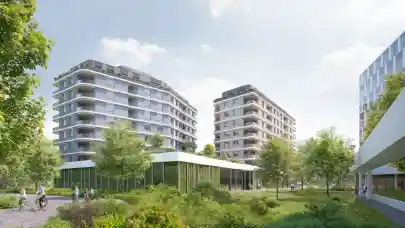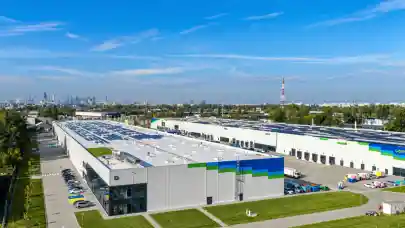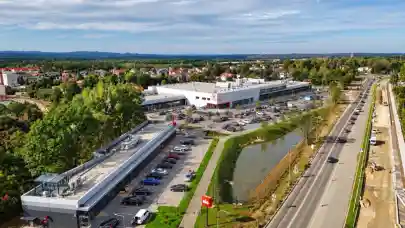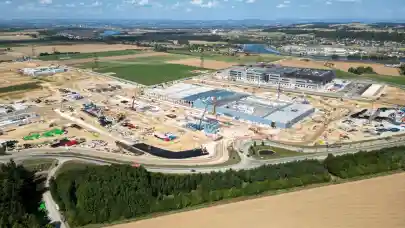
The appearance of industrial parks in the Czech Republic is changing, with developers investing not only in technical specifications but also in architecture, green spaces and employee amenities, according to an analysis by Colliers. Facades are increasingly adorned with greenery, artworks or motifs referencing local history. For example, the main facade of a distribution centre at Panattoni Park Cheb features a motif of houses from the city's historic centre, with a facade measuring nearly 700 metres in length and 15 metres in height. Brownfield sites are also being adapted, with some preserving original industrial elements such as exposed brickwork or steel beams.
"The image of an industrial park as a collection of anonymous warehouses on the outskirts of town no longer reflects reality in many cases. The quality of the environment is much more important today than it used to be; companies are focusing on architecture, the amount of greenery and places where employees can spend their breaks. As a result, industrial zones are increasingly becoming more like campuses," said Desanka Timkovská of Colliers.
Accessibility for employees is becoming a growing priority alongside highway access, with proximity to railways, public transport and cycle paths now influencing site selection. Automation and technological demands are pushing manufacturing companies to seek engineers, IT experts and technicians, making proximity to technical universities more important. This is directing investor interest beyond the traditional centres of Prague, Brno, Plzeň and Ostrava toward regional cities such as České Budějovice, Olomouc, Přerov, Vysoké Mýto and Svitavy, where rents range between €5.20 and €5.80 per sqm per month, compared with €7.00 to €7.50 per sqm per month in the Prague area.
Although construction costs in the Czech Republic are higher than in Poland due to stricter building codes and more complex permitting processes, Colliers points to lower ongoing service fees as an offsetting factor. "Compared to Poland, the Czech Republic has long had lower service fees associated with building operations. These remain at a level of €0.75 to €1.00 per sqm per month. Combined with lower energy consumption in modern, certified buildings, total operating costs in the Czech Republic may be more advantageous for tenants in the long run," noted Desanka Timkovská.
In the first half of 2026, developers delivered 446,200 sqm of new industrial and logistics space, with 69% concentrated in Prague and the Central Bohemian Region. Approximately 1.46 to 1.7 million sqm is currently under construction across more than 170 parks, with CTP Invest accounting for 45% of ongoing construction. The vacancy rate has risen to 5.5%, representing around 753,400 sqm of available space, the highest level since the third quarter of 2015, though Colliers considers this a healthy level approaching natural market equilibrium. Approved but unstarted projects represent over 2.7 million sqm, with a further roughly 2.5 million sqm awaiting approval, bringing potential future supply above 5.2 million sqm.
The composition of demand is also shifting. Manufacturing companies accounted for 41% of gross realised demand in the second quarter of 2026, while logistics and distribution each represented 21%. Colliers attributes this shift in part to ongoing nearshoring, the relocation of manufacturing and supply chain operations closer to European markets.