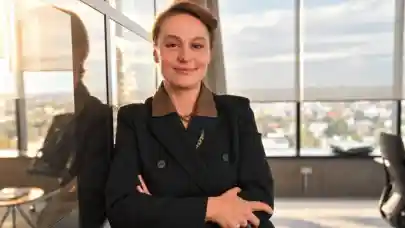
Adinel Tudor, CEO of EVO Properties, talked to Property Forum about the evolution of the Bucharest office market, noting that by 2026, the sector will become increasingly polarised. At the same time, he added that tenants are choosing better spaces even if they opt for smaller office surfaces.
What trends in tenant demand motivated the transformation of London and Oslo buildings into a multifunctional hub, and how do you see these trends evolving in 2026?
Over the past few years, the office has fundamentally changed its role. In 2025, companies are no longer looking just for sqm or efficiency, but also for the daily experience the workplace delivers to people.
At EVO Properties, we saw that tenants consistently choose our buildings because we actively support a 360-degree approach, centred on people, integrating well-being, services, culture, real collaboration and, of course, specialty coffee. London and Oslo were pioneering this shift in the Romanian market.
In 2026, offices will clearly continue to evolve into complete ecosystems, integrating work, services, social interaction and urban connectivity. The focus will be even more explicitly people-driven. Everything will be increasingly centred on real people’s needs.
What types of tenants are showing the most interest in your hub, and what are their key requirements when choosing office space today?
The strongest interest comes from companies in business services, technology, finance, professional services and other consumer industries. These are businesses that understand the office as a strategic asset for building teams and culture, not just a cost line in the P&L.
Their expectations go far beyond flexibility. Accessibility, proximity to public transport and a strong mix of integrated services—fitness, medical, food concepts and informal social areas—are essential. What they ultimately want is an environment that attracts talent, keeps teams engaged and supports long-term performance.
How does the tenant diversity shape your leasing strategy and building design?
We see tenant diversity as a competitive advantage. It pushes us to stay relevant, adaptable and ahead of market expectations. Our leasing strategy focuses on tenants’ compatibility, building communities where different industries can coexist and benefit from each other. From a design perspective, this translates into flexibility in partitioning floorplates, shared spaces that naturally encourage interaction and investment in buildings infrastructure development. London and Oslo Office Buildings were designed to grow together with their users, not to lock them into a fixed framework.
What is your outlook for the Bucharest office market in 2026, especially in terms of demand for flexible, high-quality spaces? Are you seeing a shift in how companies approach location and amenities?
For 2026, we see three very clear forces shaping the Bucharest office market. First of all, the market will become increasingly polarised. Demand will concentrate almost exclusively on high-quality, well-located projects that deliver real value beyond the standard office function. Secondly, it is the year when high-quality buildings supply and tenants’ demand will reach an equilibrium point.
Companies are far more selective today, but in the past two years, deliveries reached a historic low. Thirdly, even when leasing fewer sqm, tenants are choosing better spaces. Accessibility, user experience, amenities and the ability to support hybrid work models will weigh more than ever in decision-making.
How important is sustainability in attracting new tenants, and what ESG features are most valued?
Sustainability is no longer a differentiator—it is a baseline expectation. What has changed is how tenants assess it. Certifications alone are not enough. Tenants now focus on how sustainability is experienced day to day: energy efficiency, air quality, thermal comfort, well-being-oriented facilities and operational efficiency. At EVO Properties, sustainability is designed to be felt, not just reported.
There’s growing concern about the lack of premium office projects in Bucharest. What do you believe defines a quality office development today, and how is EVO Properties addressing this gap?
A quality office development today is one that remains relevant over time. It combines strong location, accessibility, flexibility and a clear focus on people. At EVO Properties, we address this gap by updating our existing assets with the future in mind. London and Oslo are a clear case of how classical office buildings can be transformed into multifunctional communities that support both business performance and quality of life.
The multifunctional hub includes hospitality, wellness, cultural, and retail components. How do these elements enhance the tenant experience and contribute to long-term occupancy?
These components create rhythm in the daily office routine. They reduce friction, encourage interaction and make the workplace more human. Fitness, medical services, cultural spaces, community events and food concepts are not extras; they are part of the work communities' glue. This directly translates into higher satisfaction, stronger engagement and longer-term occupancy.
Looking ahead, are there plans for new investments in Bucharest or other Romanian cities? What criteria guide your expansion strategy, and are you exploring other asset classes beyond offices?
We remain open to opportunities where revitalising existing assets and transforming them into multifunctional communities can generate real impact. We are highly selective and disciplined in where and how we invest. Across all locations, our objective is consistent: to create spaces designed for people, adaptability and long-term value.