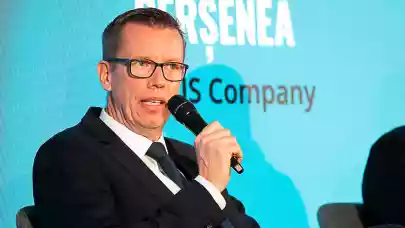
In a video interview recorded at CEE Property Forum 2025 in Vienna, Dieter Knittel, Head of CEE at pbb Deutsche Pfandbriefbank, shares his outlook on asset classes, deal activity and investment priorities for the year ahead. He explains why diversification is back on the agenda, why CEE remains one of the bank’s core focus markets, and how deal sizes and structures are evolving.
What do you expect different asset classes to perform this year?
What we see right now is that many clients are looking across different asset classes, and that’s a very positive development. In the past, there were periods when investors did not like retail anymore, and then times when offices fell out of favour. Today, however, investors are looking at student housing, data centres, retail — including retail parks — offices, and of course logistics.
Logistics remains the dominant asset class, but what is encouraging is the wide range of asset classes under consideration. That’s why I believe we will see many different types of deals next year, which is a good sign for the market.
Are you switching focus going into 2026? Are you looking at new countries?
We are always driven by our clients and by competition. We see increasing competition across the market, with a lot of liquidity coming from capital markets, debt funds and other banks. This means we have to take a proactive approach.
CEE is a market we like very much. When looking across Europe, CEE stands out as one of the more interesting regions at the moment. It is relatively stable, close to the larger Western European markets, and still attractive in terms of yields. That’s why we see new deals happening here, similar to markets like Spain. CEE is clearly one of the regions where we are putting a lot of emphasis, and I expect we will do significantly more business here next year.
Are there any asset classes you would be focusing on next year?
Logistics is a clear volume driver. If you want to do large transactions — €100 million or €200 million deals — logistics makes that possible. For example, we recently completed a pan-CEE financing covering Poland, the Czech Republic and Hungary.
Beyond that, we are also increasingly looking at logistics developments. This is something we would not have done a few years ago, but today we are financing development projects even on a pan-European basis. At the same time, we are also looking at asset classes such as student housing. If there is a buyer acquiring a platform — for example, in Poland — we would be very keen to finance it.
There is strong competition, which is a good sign. High liquidity shows that the market is healthy. When we look at our pipeline, we already see several deals lined up for next year, so we are quite positive.
Can you tell us about the size of the deals you are looking at?
We have to stay flexible. We are doing smaller deals alongside larger ones. For example, we have recently secured financing for an older office building in a very good location in central Warsaw. What makes this deal interesting is the brown-to-green strategy — we have agreed on specific initiatives to make the building more sustainable over a defined period.
These transactions are smaller in volume compared to our largest deals, but we run them in parallel with bigger transactions. The same applies to retail parks. A single retail park may be too small, but a portfolio of ten retail parks can make sense. That’s the type of structure we are actively looking at.