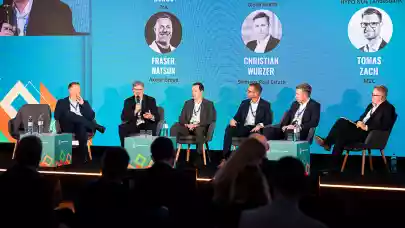
At CEE Property Forum 2025, one message dominated the discussion on offices: standing still is no longer an option. Chaired by Paweł Nowakowski MRICS, Founder and CEO of PNC, the panel brought together investors, occupiers, lenders and developers to examine how the office sector in CEE is being reshaped by new work patterns, rising expectations from tenants and financiers, and growing pressure to reinvest in quality, experience and efficiency. The conversation focused less on whether offices still matter—and more on which ones will continue to matter in the years ahead.
Addressing the shift in work habits since the pandemic, Christian Wurzer, Head of Asset and Property Management Central Europe for Siemens Real Estate, explained, “Our organisation continues to shrink its office portfolio as hybrid and remote work have become more deeply ingrained. Although offices remain vital for collaboration, research, and company culture, it is clear that the days of one-size-fits-all are over. We have moved strongly toward high-quality, premium spaces that truly entice people to return, ensuring that each location is more than just a place to work.”
Fraser Watson, Head of Real Estate at Axelor Group, drew a compelling parallel between today’s office market and the retail sector’s transformation a decade ago. He observed, “Just as retail faced an existential threat from the rise of online commerce and emerged as a reinvented, highly investable sector, so too must offices adapt to a new reality. ‘The new office reality isn’t about survival; it’s about understanding what tenants want and evolving accordingly. If we get this right, offices will not only survive but will reclaim their appeal for sophisticated investors.’” Watson went on to note that Prague’s unique supply-and-demand dynamics favour core-location investments, but warned that the sector’s evolution would hinge on active adaptation and tenant-centric thinking.
Offering the lender’s perspective, Péter Számely MRICS, Head of Real Estate Finance CEE at HYPO NOE Landesbank, acknowledged the accelerating changes but cautioned that they began even before COVID-19. He commented, “This sector has been in transition for years, with flexible space and technological enhancements leading the way. COVID may have been a catalyst, but the real transformation is about creating offices that genuinely attract employees and support evolving work styles. Banks and lenders firmly believe in offices, but we are equally convinced that only those embracing adaptability and employee well-being will deliver consistent long-term value.”
Representing the developer’s view, Andrei Boca, Leasing Director at Globalworth, emphasised flexibility, amenities, and certifications as the new standards for competitive office environments. “What mattered in 2019—such as 100% occupancy and high-density use—is simply no longer relevant, because employee expectations and workplace flexibility have profoundly shifted,” Boca remarked. “‘Successful offices today go beyond workspace: by offering amenities, robust community programs, and accredited certifications for quality and accessibility, we make the buildings truly attractive. Innovation is now about creating an experience rather than simply providing space.’”
Tomas Zach, International Business Director and Country Manager Romania at M2C, spoke to the critical role of technology in this reinvention. “Adopting building automation and smart sensors is no longer a luxury; it’s a necessity if we want to create comfortable, efficient environments for tenants,” Zach stated. “By leveraging advanced technologies to monitor occupancy and energy use in real time, we not only reduce operational costs but also enhance occupants’ overall well-being. The path forward is clear: invest in smart solutions to stay ahead in the competitive office market.’”
Throughout the session, the panellists collectively championed energy efficiency, green leases, and technological innovation as pillars of a successful repositioning strategy. Although the discussions ranged from location economics to the potential repositioning of B and C class assets, the consensus was clear: the “new office reality” demands adaptability, a focus on user experience, and a willingness to invest in sustainable, value-adding innovation.