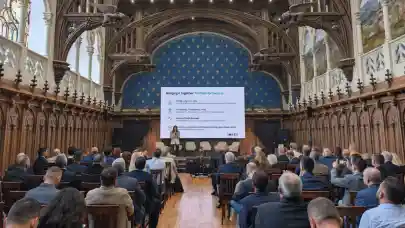
Property Forum’s first EastGate Investment Showcase, held on 15 September, brought together investors, business leaders, financial institutions, public authorities and regional decision-makers at the Palace of Culture in Iași to explore how Northeast Romania and the wider Romania-Moldova-Ukraine corridor can translate its strategic position into investable opportunities. The event created a new meeting point between international capital and regional stakeholders, with discussions ranging from infrastructure and energy to real estate, logistics and Ukraine’s reconstruction. EastGate’s objective extends beyond the event itself: the initiative will continue with the development of the EastGate Investment Pipeline 2027, aimed at identifying and preparing concrete opportunities for investors.
Two keynote presentations approached the region’s opportunity from different but complementary perspectives. Iryna Pylypchuk, Director of Research and Market Information at INREV, explored what Romania, Moldova and Ukraine need to do to attract meaningful international investment, while sustainability strategist Paul Toyne focused on how that capital can be deployed to create places capable of delivering economic, social and environmental value over the long term.
Security can become an investment argument
Europe’s geopolitical landscape has fundamentally changed, Pylypchuk told the audience, arguing that security considerations are increasingly becoming intertwined with economic competitiveness. While Europe has traditionally been successful at creating legal and regulatory frameworks, implementation remains considerably slower. Pylypchuk pointed to the implementation of Mario Draghi’s recommendations on European competitiveness, noting that fewer than 16% of the initiatives have so far been completed. Progress, however, has been considerably stronger in areas where economic competitiveness overlaps with security, including the phase-out of Russian gas, defence financing and support for Ukraine.
“Security pressure creates movement,” she said, arguing that this provides an important lesson for the Eastern Growth Corridor. The region needs to frame its economic proposition not simply around growth potential, but around its wider strategic importance to Europe.
Romania, Moldova and Ukraine each bring different strengths to this proposition. Romania’s geographical position, Black Sea access and proximity to Ukraine make it strategically important to both NATO and the EU. Moldova, meanwhile, has transformed its energy system, moving from complete dependence on Russia for gas and electricity towards energy independence in less than five years, while renewable energy has grown rapidly.
Ukraine’s role could become even more significant. In addition to its importance to global food supply and European security, reconstruction could provide the scale needed to accelerate modern methods of construction, automation and digitalisation across Europe. Pylypchuk argued that these strengths correspond closely with some of the areas in which Europe itself needs to improve competitiveness. Romania’s potential in energy, Moldova’s strengths in IT, pharmaceuticals and electronics, and Ukraine’s growing expertise in automation, digitalisation and defence could therefore form part of a broader European strategic proposition.
Residential and logistics remain firmly on investors’ radar
Real estate investment trends could also work in the region’s favour. INREV’s annual Investment Intentions Survey shows residential as the most sought-after European real estate sector among investors, followed by industrial and logistics. According to Pylypchuk, 85% of surveyed investors selected European residential as a preferred asset class this year. The structural shift has already significantly changed institutional portfolios: residential represented around 26% of European real estate fund portfolios at the end of 2025, compared with less than 12% 15 years earlier.
There are also signs of investors looking beyond Europe’s traditional core markets. Spain and Ireland have entered the top ten preferred investment destinations, while CEE has begun gaining momentum. Pylypchuk said 15% of surveyed investors selected the region, roughly twice its longer-term average of 7-8%.
The challenge is converting that interest into capital flows.
Pylypchuk identified three essential ingredients: policy, transparency and scale. Rather than presenting individual opportunities in isolation, Romania, Moldova and Ukraine should work towards a coordinated, investor-ready proposition supported by predictable regulation, planning, taxation and infrastructure.
Ireland provides a useful example. Following the global financial crisis, when Irish real estate values had fallen by around 50%, the government introduced a coordinated package of tax and investment measures to attract international capital. Investment subsequently recovered strongly and international capital became a major part of the market. More recently, Ireland has applied a similarly coordinated approach to housing, combining planning reform, infrastructure, taxation and modern construction methods. The reaction from investors has been rapid: according to INREV’s latest survey, Ireland's residential sector has risen into the six most preferred country-sector combinations in Europe.
For the Eastern Growth Corridor, Pylypchuk argued that the lesson is clear. Governments and the private sector need a common message, stable policies and a pipeline large enough to attract institutional capital. “It’s not about thinking about one project at a time,” she concluded. “It’s about building a strategic landscape structured as a holistic investor-ready proposition.”
Capital alone will not guarantee successful development
Paul Toyne took the discussion one step further. Attracting investment is only part of the challenge, he argued. How that capital is ultimately deployed will determine whether the region creates resilient places or repeats mistakes already visible elsewhere in Europe.
Toyne pointed to the UK as an example of unintended consequences created by conventional development. Homes have been built that overheat during increasingly hot summers while remaining expensive to heat during winter. Construction continues to consume large quantities of resources and generate waste, while transport and development patterns contribute to poor air quality and the loss of nature.
Simply improving existing practices will therefore not be sufficient. “We need to have radical transformation of our approach,” Toyne said, calling for a shift towards regenerative design. Rather than designing buildings and infrastructure simply to reduce their negative environmental impact, regenerative design asks how development can actively improve the places and communities around it.
For the Eastern Growth Corridor, this means looking beyond individual buildings and considering the entire system: energy, water, materials, transport, biodiversity, housing, healthcare, education and employment. Development should respect local heritage and ecology while improving health and quality of life, Toyne argued. Buildings should make greater use of natural ventilation and daylight, infrastructure should support mobility and accessibility, and assets should be designed for longevity and resilience against physical risks including heat, drought and other climate-related disruption. The central shift, he said, is moving from doing “less harm” towards doing “more good”.
From ESG promises to measurable outcomes
Toyne also highlighted a broader change in the sustainability debate. Investors and developers are increasingly being asked not simply to promise environmental performance but to demonstrate it. Certification and performance measurement therefore have an important role, but carbon cannot be the only metric. Water, health, biodiversity, social equity and resilience are interconnected, meaning that developments need to be assessed as part of a wider system. The social dimension is particularly important. Investment in infrastructure and real estate can also be used to create skilled employment, strengthen local supply chains and develop expertise through cooperation with universities and educational institutions.
For a region expecting significant infrastructure and real estate investment, this represents an opportunity to ensure that incoming capital creates value locally rather than simply delivering physical assets.
Toyne stressed that there is also a financial argument for this approach. More desirable and resilient places can improve tenant attraction and retention, reduce operating costs and protect investment value against climate and supply-chain risks. Better designed places can simultaneously generate social value through health, education, skills and quality of life while protecting the natural assets on which communities depend.
Building an investable corridor
Taken together, the two keynotes highlighted two sides of the same challenge facing the Eastern Growth Corridor. Romania, Moldova and Ukraine have a combination of geography, infrastructure needs, human capital and strategic importance capable of attracting substantially greater investment. But international capital requires scale, predictability and a clear proposition. At the same time, attracting capital should not become an objective in itself. Decisions being made today around infrastructure, housing, logistics, energy and reconstruction will shape the region for decades.
The opportunity for the Eastern Growth Corridor is therefore not simply to catch up with more developed European markets. It is to use the scale of investment expected across the region to build differently, combining an investor-ready economic proposition with infrastructure and real estate designed around resilience, productivity and long-term quality of life.