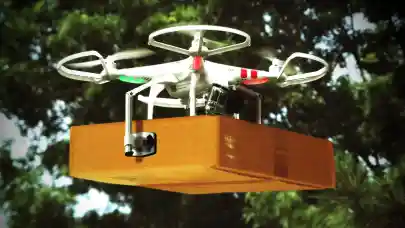
Drone delivery services that can drop groceries, restaurant meals and over-the-counter medications at a customer's door within 15 minutes are already operating commercially in parts of the United States. A new analysis by Colliers examines how the expansion of such networks is reshaping thinking about retail real estate, with unused parking lots and back areas of shopping centres and retail parks emerging as the most viable launch sites.
The report notes that China is currently the most advanced market for drone delivery, while the US is catching up rapidly. Walmart announced in May 2026 that it had completed one million drone deliveries, while operators Wing and Zipline and delivery platform DoorDash have all expanded drone operations. Typical orders include small grocery restocks, drugstore items and restaurant meals, where customers are willing to pay a premium for speed and convenience.
The economics of drone delivery remain challenging. A single drone delivery cost roughly $13.50 in 2025, compared with around $2 for a conventional vehicle delivery. "The cost per shipment falls as the number of takeoff points in a metropolitan area rises. The denser the network, the shorter the flights and the cheaper each delivery becomes. Securing suitable sites is the key factor that shapes the entire cost curve," said Blanka Sovová, director of the Retail Real Estate Department at Colliers.
Existing commercial deployments have concentrated in suburban areas with low air-traffic complexity. Amazon is installing launch pads of approximately 1,860 sqm in parking lots near Chicago, with a service radius of around 12 kilometres. DoorDash and Wing operate from an outlet mall in the Atlanta area, while Zipline runs more than 25 public sites across the Dallas-Fort Worth metropolitan area. In Europe, Irish operator Manna has completed more than 250,000 deliveries since 2019, running stations from suburban shopping centre parking lots occupying roughly five parking spaces each. The European Commission has estimated the EU drone services market could reach €14.5 billion by 2030. "Drone infrastructure doesn't require new construction. It can make do with an unused section of a parking lot or the back area of an existing shopping center. For property owners, the deciding factor is whether their building can support such operations technically and process-wise," Sovová added.
In the Czech Republic, activity remains at the pilot and demonstration stage. E-commerce retailer Mall.cz conducted the first test flight in November 2016, covering 1.7 kilometres in three minutes under Civil Aviation Authority supervision. Czech delivery company Dodo tested a 15-kilometre drone flight with the Rossmann drugstore chain in Budapest in January 2023, and drone developer Aerovision opened a development centre at Příbram airport in March 2025. Delivery platform foodora has been running three autonomous ground robots for McDonald's orders in Prague's Karlín district since December 2025, with plans to expand if the pilot succeeds. "Czech customers are accustomed to fast, contactless delivery, and parcel lockers already occupy part of the parking lots at supermarkets and retail parks. If drone operations are liberalised after the launch of U-space, shopping centres and retail parks on the outskirts of cities will have a head start. Owners should determine now whether their property is suitable for a takeoff area," concluded Sovová.