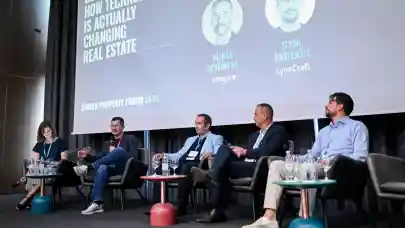
At the CEE Property Investment Update 2026 in Warsaw, the focus quickly shifted from headline risks to underlying resilience. Bringing together investors, bankers, lawyers and asset managers, the opening panel examined how Central and Eastern Europe’s real estate markets are being shaped by geopolitical volatility, energy transformation and shifting capital priorities – and why, despite the noise, many fundamentals continue to support long-term investment. Moderated by Dorota Wysokińska-Kuzdra of Colliers, the discussion set out to separate short-term disruption from structural opportunity in a region increasingly tested by global change.
Dorota Wysokińska-Kuzdra, chairing the panel, quickly foregrounded the day’s central theme: “We simply cannot escape the topic of geopolitics, not only with events in Ukraine but also broader tensions involving Venezuela, Iran, and the United States with China. The essence of our discussion is how these shifting geopolitical sands are reshaping both real estate and global capital flows, particularly for Poland and the wider CEE region.” Her opening remarks provided a framework for the dialogue, inviting panellists to weave their insights around these seismic changes.
Janusz Dzianachowski, National Managing Partner at Addleshaw Goddard, affirmed the difficulty in predicting the dynamic consequences of geopolitics on real estate investment. “The global environment has changed so rapidly over just the last weeks that it is impossible to gauge the ultimate effect of these events,” he said. “Nevertheless, we see international business maintaining its strategic outlook, exemplified by U.S. companies continuing to plan major meetings and investments in Warsaw -a clear sign that confidence in the region’s stability persists.” Janusz stressed that while local and regional capital are important, only international capital influx could fuel the full potential of the Polish market, noting, “With Poland as Europe’s fastest-growing country and Warsaw as its fastest-growing capital, there’s a vast stock of commercial real estate and an even greater opportunity if we can unlock global liquidity.”
The German investment perspective was offered by Peter Heckelsmüller of Deka Immobilien Investment GmbH, who painted a measured picture of the European market’s current realities. “Germany continues to feel deep macroeconomic and energy cost pressures, influencing not just domestic but regional investment decisions,” said Peter. “Despite these short-term concerns, our investment philosophy remains grounded in thorough evaluations of economic fundamentals -not knee-jerk responses to shifting geopolitical winds.” He acknowledged the persistent challenges in securing core investments as large, institutional players pull back, but remained optimistic about the resurgence of regional and state-owned investors: “While Polish capital can capably cover deals up to €100 million, only core investors bring the necessary scale for landmark transactions.”
João Saracho, Managing Director at Solida Capital Europe, shifted focus toward the mounting competition between infrastructure and real estate. “Infrastructure is now outperforming real estate on a global level, especially as European policy and capital increasingly target defence and energy resilience,” João remarked. “We have invested heavily in green technologies, and that transition, while costly, is positioning markets like Portugal and Spain to achieve measurable independence from volatile sources. In Warsaw and the CEE landscape, we see accelerated investment in sectors where Europe has previously lagged, and our strategy is to capitalise on these emerging opportunities while recognising that AI and digital transformation are redefining not just property management, but also employment and space planning.”
Tomasz Tondera, Country Manager at Adventum Group, brought attention to pragmatic market realities. “Energy efficiency and cost have taken centre stage for our tenants, who now scrutinise service charges and demand forward-thinking responses from landlords,” Tomasz explained. “Poland’s recent entry into the world’s top 20 economies will attract new players and reinforce our perception as a stable, liquid, and increasingly competitive market.” He expressed confidence that with proactive energy management and continuing efforts to enhance building efficiency, the sector is well-positioned for medium- to long-term stability.
Banking perspectives were provided by Georg Blaschke of Helaba, who highlighted a steady approach to real estate finance. “It is fundamentals, not geopolitics, that drive our lending decisions; stable construction volumes, rental rates, and unemployment figures create a favourable environment in Poland and CEE,” Georg explained. “The Polish market’s resilience and the positive forecast for 2026 are drawing more financing competition, which will ultimately benefit developers and borrowers alike.” However, he cautioned, “The market should be vigilant about the risk of short-term refinancing pressures from deals struck in 2019 and the need for rigorous tenant due diligence to avoid long-term underperformance.”
“Poland remains open, consistent and highly collaborative in its approach to investors, and by sustaining this focus on transparency, efficiency and partnership, the country can further strengthen its position as one of the most attractive and competitive markets in Europe. It is also reassuring that the broader CEE region - and Poland in particular - continues to be underpinned by strong fundamentals, which reinforce confidence in long‑term performance and future growth,” concluded Dorota Wysokińska-Kuzdra. Az űrlap teteje
As the panel drew to a close, the consensus emerged that while global uncertainties -ranging from wars to regulatory shifts -will persist, the fundamentals remain robust. Investment success will depend on agile adaptation, a focus on quality assets, the harnessing of technological advances, and a willingness to embrace both regional and international capital.