Four and a half years into the full-scale invasion, Ukraine has developed a real estate category no market study anticipated: the civilian shelter as a designed, engineered and increasingly branded space. What began as bare concrete basements is evolving into a distinct segment shaping how schools, universities and residential communities plan, budget and build. The URE Club (Ukrainian Real Estate Club) has summarised the situation in an article for Property Forum.
Ukraine's investment potential will be a key topic at the upcoming EastGate Investment Showcase 2026, a unique event bringing together investors, business leaders, public authorities and regional decision-makers for a focused discussion on the investment opportunities emerging across Northeast Romania and the wider Romania–Moldova–Ukraine corridor.
A legal precondition, not an amenity
Under Ukrainian legislation, no educational institution may hold in-person classes without a certified safe space on site. The absence of a shelter is not a quality issue — it is an automatic bar on offline schooling, regardless of how well a building itself has been repaired. This single requirement has turned shelter construction into the binding constraint on Ukraine's education infrastructure, and increasingly on residential and commercial development more broadly.
Construction standards are strict on structural matters: load-bearing walls generally cannot be plastered or clad with additional decorative layers, ventilation, autonomous power, water supply and at least two independent evacuation routes are baseline requirements, and protective shelters must be engineered to absorb blast and fragmentation impact rather than merely provide cover. Within those constraints, however, developers, universities, foundations and local authorities have started competing on design, function and psychological comfort — effectively creating a new product category.
From basements to smart hubs: CLUST SPACE
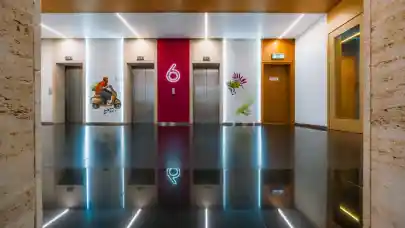
The clearest example of this shift is CLUST SPACE, a 600 sqm smart shelter built inside a former archive at the Igor Sikorsky Kyiv Polytechnic Institute. Delivered by architecture firm Peker & Partners for IT company CLUST, backed by Freedom Holding and charitable partners, the space combines a certified shelter — with 72-hour autonomy, filtered ventilation and injury-prevention detailing such as rounded furniture and laminated glass — with a full coworking programme: open-plan zones, meeting rooms, call booths, a kitchen and recreational areas. Since opening in January 2024, it has hosted more than 350 events and over 130,000 visits, and won a Red Dot Award in 2025. A second facility has since opened at Oles Honchar Dnipro National University, with the model designed to scale to other Ukrainian campuses.
Fairy-tale shelters for children: the Gurtum experience
For younger children, Ukrainian charities are tackling a different problem: the psychological toll of housing pupils in cold, windowless concrete rooms. In the Kyiv region, the Gurtum Foundation has built a series of themed shelters at schools and kindergartens that reopened after occupation or shelling damage. The first, Hobbit House in Hostomel, is built into a landscaped mound with round windows and doors evoking Tolkien's Shire, funded through a mix of Japanese NGO support, a construction partner's discounted rates and volunteer labour; it allowed 170 children to return to in-person classes. Subsequent projects scaled the concept further — a 120 sqm "space shelter" for up to 200 people, complete with a mini cinema, and additional themed facilities for kindergartens rebuilt after frontline occupation, financed through a combination of Japanese philanthropic partners, local administrations and construction-cost discounts from private developers. Each project follows the same underlying logic: a certified, blast-resistant structure is a legal prerequisite, but its interior treatment determines whether children experience it as a threat or as a normal part of daily life.

Kharkiv: shelters at municipal scale
Nowhere is the shift toward shelter infrastructure more visible than in the Kharkiv region, where frontline proximity has forced local authorities to build at a scale closer to a public transit network than a series of individual projects. Seventeen underground schools were operating by mid-2026, with regional authorities targeting 30 by year-end — infrastructure expected to move roughly 100,000 pupils from online to in-person or blended learning. In July 2026, the region opened Ukraine's first underground kindergarten and designed for 260 children, including a dedicated group for children with special educational needs. Combined with shelter classrooms built into metro stations, these facilities now account for the majority of safe in-person learning capacity in a city that remains under regular attack.
A segment born of necessity
Taken together, these projects point to a genuine architectural trend rather than a series of isolated responses: shelters are moving from an afterthought bolted onto existing buildings toward a purpose-built typology with its own design language, funding models and performance benchmarks. Yet the underlying driver remains sobering. Every one of these facilities exists because ordinary school and kindergarten buildings cannot legally reopen without one, and demand for such spaces — in Kharkiv above all — continues to outpace what has been delivered. Until the security situation changes, the shelter is likely to remain one of the fastest-growing and most consequential segments of Ukraine's built environment.