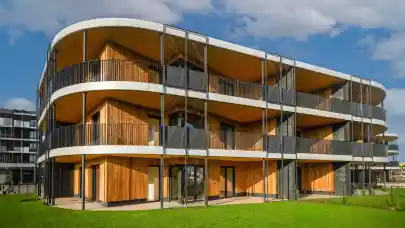
UBM Development Czechia's Timber Praha, the first multi-storey timber residential development in the Czech capital, has completed nearly two years of operation. The project, comprising four residential buildings with 62 units in the Prague district of Řeporyje, was completed in 2024 and is now fully sold and occupied.
"After nearly two years of operation, the quality of the concept and the standard of execution have both been confirmed. From a technical standpoint, the building functions without significant problems, with minimal management demands and no extraordinary maintenance requirements. In practice, we have verified that a timber building is comparable to a standard residential building constructed from conventional materials," said Josef Wiedermann, managing director of UBM Development Czechia.
Construction using prefabricated CLT panels reduced the build time significantly. "Construction from solid CLT panels was considerably faster than a conventional reinforced-concrete structure. The shell of Timber Praha was completed in just seven months," said Wiedermann, noting that this represented a reduction of roughly one third compared with a concrete equivalent. The project was originally designed as a reinforced-concrete structure but was converted to a hybrid timber construction at the end of 2021, resulting in a 11.33% reduction in CO2 emissions. The development also incorporates geothermal energy and a photovoltaic installation, and holds a PENB energy class A rating and BREEAM Excellent certification.
A resident survey covering all 62 apartment owners, with responses received from more than a quarter of those approached, recorded high satisfaction levels. Some 93.8% of respondents said they were satisfied or very satisfied with living in Timber Praha, while 87.6% said the project had met or exceeded their expectations. "One of the benefits residents value most, according to our survey, is the quality of the indoor environment, specifically light, temperature and, above all, air quality, which is better than in traditional buildings. They also appreciate the pleasant atmosphere created by the timber floors and ceilings," Wiedermann added.
Wiedermann noted that market attitudes towards multi-storey timber construction are shifting. "Initially, buyers were cautious and had many questions, as this was entirely new on the Czech market. Now people have more information, and interest in timber buildings is growing," he said. He attributed part of this trend to increasing demand for sustainable and energy-efficient homes. He also flagged a gap in financing: "Unfortunately, the Czech market does not yet have appropriate conditions for financing timber or other sustainable construction that would translate into preferential terms for builders, developers and end buyers in the form of green mortgages."
UBM was one of the co-initiators of the Platform for Sustainable Timber Construction in the Czech Republic, which contributed to a revision of Czech building norms. Updated fire regulations now permit timber buildings up to a fire height of 22.5 metres, or approximately eight storeys. "We expect the first timber buildings at the new permitted height to appear within a few years. We believe this change will significantly expand the possibilities for building multi-storey timber developments," Wiedermann said. Parent company UBM Development AG is currently preparing more than 300,000 sqm of timber-hybrid projects across Central Europe, ranging from office buildings to entire residential districts.