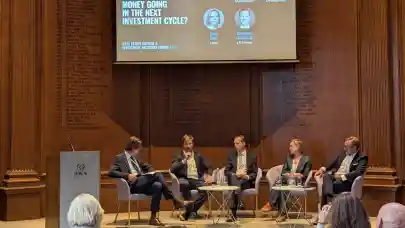
The next real estate investment cycle will be shaped less by simple sector allocation and more by income growth, operational performance, pricing and the ability to future-proof assets. During the closing debate of Property Forum's Real Estate Capital & Investment Decisions Forum 2026 in London, investors, developers and capital markets experts discussed where they see the strongest opportunities, from residential and logistics to retail, data centres and selectively chosen offices.
Emma Long, Head of Business Strategy, Real Estate Equity at Legal & General Investment Management, highlighted the continued attraction of sectors supported by long-term structural demand, particularly residential, industrial and data centres. Within residential, she sees the investment universe broadening beyond established build-to-rent strategies towards areas such as affordable housing and co-living. At the same time, investors need to look beyond fashionable sectors and identify counter-cyclical opportunities where capital has retreated too far. Offices can fall into this category in highly supply-constrained city locations, provided investors are highly selective.
Long also argued that returns are becoming increasingly dependent on income and income growth rather than cap rate compression. This favours operational real estate and strategies where managers can actively influence performance. Investors are therefore paying greater attention to how much of the value chain they control and to platforms that can generate stronger operational returns.
Christoph Schuetz CFA, Executive Director at J.P. Morgan, pointed to the changing definition of core real estate in a higher-rate environment. With government bonds offering significantly higher risk-free returns than several years ago, property needs to deliver a meaningful premium. He noted that listed European real estate companies are currently implying relatively high cash return requirements, while debt markets remain healthy and lending margins are still comparatively tight. The gap between debt and equity availability is therefore an important feature of today's market.
Schuetz also highlighted how quickly investor perceptions of individual sectors can change. Retail, largely avoided immediately after the pandemic, has produced some strong listed-market performers, while previously defensive residential investments have experienced significant repricing in markets such as Germany. Rather than relying on traditional labels such as "core", investors increasingly need to assess assets against their actual cash generation and the opportunity cost of capital.
Łukasz Komierowski, Founder and CEO of Redkom Development, offered a CEE developer's perspective, arguing that Poland continues to benefit from healthy economic fundamentals and strong consumption. Redkom therefore remains focused on retail, particularly retail parks, while increasingly looking at the refurbishment and repositioning of existing assets as prime greenfield locations become harder to find. Last-mile logistics is another area where the company sees continued demand, driven by the need for greater efficiency in distribution networks.
Komierowski also sees a narrowing window for investors seeking a pricing advantage in CEE. With stronger economic growth in markets such as Poland than in parts of Western Europe, he questioned whether today's yield differential can persist. In his view, the convergence between CEE and Western European pricing could happen relatively quickly, making the current period particularly attractive for investors looking to enter the region.
Andrew Davey, Managing Director, Head of UK Residential at CBRE Investment Management, identified residential as a particularly compelling part of the next investment cycle, although different strategies appeal to different sources of capital. Affordable housing continues to attract domestic institutional investors, while single-family housing is drawing greater interest from international capital seeking higher returns. Scale, affordability and access to large resident pools remain central to both strategies.
Sustainability was another common theme across the debate. Davey argued that future-proofing assets should be viewed as an investment and liquidity consideration rather than simply a regulatory restriction. Assets unable to meet future sustainability requirements risk becoming stranded and harder to sell. Schuetz added that required ESG upgrades are increasingly being reflected directly in asset pricing, with buyers expecting the cost of necessary capital expenditure to be borne by existing owners.
The discussion ultimately suggested that there may be no single destination for "smart money" in the coming cycle. Residential, logistics, data centres and selected retail opportunities remain attractive, while even offices can offer value where supply constraints and pricing create the right conditions. What increasingly separates attractive investments from the rest is the ability to generate and grow income, actively manage operations and capital expenditure, and maintain long-term liquidity.