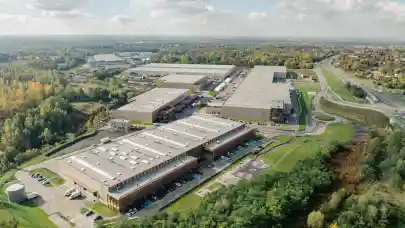
Łódź remains the economic anchor of Central Poland's warehouse market, but new development is increasingly spreading to satellite cities such as Stryków, Zgierz, Piotrków Trybunalski and Łowicz. According to Newmark Polska, the region holds nearly 5.2 million sqm of warehouse space, with a further 160,000-plus sqm under construction. While a third of total stock is concentrated in Łódź, neighbouring cities are steadily gaining ground, led by Stryków and Piotrków Trybunalski. Satellite cities attract developers with land availability and good road infrastructure along the A1, A2, S8 and S14 routes, while tenants benefit from lower leasing and labour costs.
Central Poland is developing as a single market in which individual cities play distinct roles. "Łódź's advantages include a large labour market, a robust academic and skills base, as well as a well-developed logistics and industrial sector," says Jan Olszewski, Senior Advisor in the Industrial and Warehouse Department at Newmark Polska. "This translates into growing demand for last-mile logistics, set to be one of the key segments of the local market." Jakub Dudkiewicz, Regional Director at Newmark Polska, explains why large-format facilities gravitate elsewhere: "Large plots of land are needed to develop big-box projects, and these are increasingly in short supply across Łódź. This is why smaller industrial parks, typically ranging from 20,000 to 50,000 sqm, tend to be developed in Łódź, while big-box facilities exceeding 100,000 sqm are built in secondary locations."
Stryków, located at the A1 and A2 interchange, already accounts for over one million sqm of warehouse space, representing more than 20 per cent of Central Poland's total stock, with a further 38,000 sqm under construction. Developers active there include Hillwood, Logicor, Segro, Prologis and Panattoni. However, the density of occupiers has created labour competition. "Today, employees have a wide choice of job opportunities and benefit from competitive employment conditions, making it increasingly difficult for new investors requiring a large workforce to compete for talent," says Dudkiewicz. Zgierz, with nearly 270,000 sqm of production and warehouse space, can absorb some of this demand, with Hillwood and Panattoni already present there.
Piotrków Trybunalski, situated at the A1 and S8 junction, serves as the region's southern logistics hub, with Prologis, Mapletree, P3 and Reino among its active developers. "Thanks to the proximity to the intersection of two key transport axes, our clients are able to shorten journey times, consolidate cargo flows and improve operational flexibility," says Jacek Freund, CEO of xCargoLogistics. Łowicz, meanwhile, draws tenants primarily through its position between Łódź and Warsaw and its lower costs. "Łowicz attracts warehouse tenants thanks to its proximity to Warsaw and its lower labour and leasing costs," says Olszewski. E-commerce firm SellBEST, a tenant at Hillwood Łowicz, cites the ability to centralise logistics from import receipt to pan-European distribution as its key reason for choosing the location, with General Director Agnieszka Wereska noting it offers the advantages of Central Poland while avoiding congestion and labour competition typical of larger cities.
Marek Sekieta, CEO of the LODZistics Cluster, argues that the region's strength lies in its broader ecosystem. "Its advantage lies in the broader market environment, while connecting the potential of universities with the needs of the economy is gaining importance," he says. "Companies are no longer asking how many graduates they could recruit, but about their skills and whether they will be prepared for the changes taking place in the economy." Corning, which operates a production and technology centre in Stryków, echoes this view. "Availability of skilled engineers graduating from higher education institutions in Łódź province was of paramount importance for us," says Łukasz Srogosz, Regional Manufacturing Manager EMEA OCS at Corning, adding that local talent has enabled the firm to establish an R&D centre serving the EMEA region.
Looking ahead, Olszewski points to inter-city cooperation and the planned Central Communication Port (CPK) as key growth drivers. "What will matter above all is people and their capabilities, as well as the ability of companies, local governments and institutions to work together. The whole province remains cost-competitive compared with the rest of Poland. Today, we have an opportunity to strengthen the advantages of the region, where individual cities are honing their specialisations while reinforcing one another," he concludes.