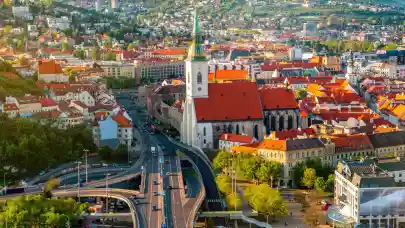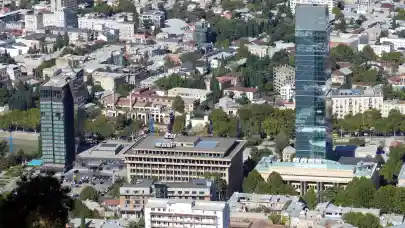
For decades, the geography of European real estate investment has been expanding eastwards. Markets once considered peripheral have become established destinations for international capital, with Central and Eastern Europe developing sophisticated commercial property sectors, institutional investment markets and increasingly international developer communities.
But the map of opportunity does not stop at the traditional boundaries of CEE.
Across the Caucasus and Central Asia, infrastructure investment, industrial development and changing economic relationships are creating new demand for logistics facilities, commercial space and urban development. These markets are at different stages of maturity, but collectively they merit greater attention from the international property industry.
The economic backdrop is significant. Several economies across the region are recording growth rates that compare favourably with those of much of Europe, supported by investment in infrastructure, manufacturing, technology and services.
Of course, GDP growth does not automatically translate into investable real estate opportunities. The more interesting question is how economic change is reshaping demand for the physical infrastructure of business.
One of the clearest examples is connectivity.
Across Eurasia, investment in transport infrastructure, logistics networks and regional trade links is creating new possibilities for industrial development, distribution facilities and commercial real estate.
Much of the attention has focused on the Trans-Caspian Middle Corridor, connecting Central Asia with Europe through the Caspian and South Caucasus. But the wider opportunity is not limited to any single route. New and potentially reopened connections could strengthen links between neighbouring economies, expand access to markets and encourage investment in the infrastructure and facilities that support trade.
Armenia offers an interesting example of how this thinking is evolving. Its Crossroads of Peace initiative envisages a more interconnected region through the development and reopening of transport links. For Armenia, the significance extends beyond transit. Improved regional connections could complement its strengths in technology and engineering, support industrial and logistics development, and create opportunities for investment in energy, infrastructure and urban projects.
These developments illustrate an important distinction for the property industry: connectivity creates opportunities not simply where goods pass through, but where businesses choose to establish operations, develop supply chains and invest in productive capacity.
The region's property opportunities are also becoming more diverse. Across the Caucasus and Central Asia, investment in manufacturing, technology, tourism and urban infrastructure is creating different forms of demand for real assets.
The expansion of industrial activity, logistics networks and hospitality is generating opportunities for developers, operators and specialist investors. Kazakhstan and Uzbekistan, for example, are seeing growing interest in modern industrial and warehousing facilities, while tourism and urban development are creating different opportunities across the Caucasus.
What connects these markets is not a single property investment model, but the relationship between wider economic development and demand for real assets.
There are important distinctions. Some opportunities may appeal to conventional developers and property investors, while others are more relevant to infrastructure funds, contractors, operators, development finance institutions or investors willing to participate in earlier-stage projects.
Institutional real estate markets also require more than attractive growth forecasts. Transparent ownership structures, reliable valuation data, effective planning systems, financing options and credible exit routes all influence whether international capital can participate at scale.
These considerations are especially important in markets where commercial property investment remains relatively young. But market maturity should not be confused with the absence of opportunity. In many emerging economies, considerable scope for investment lies in developing the infrastructure, facilities and urban environments that expanding businesses require.
There is also a wider geopolitical dimension. As companies reassess supply chains, diversify production locations and seek access to new consumer markets, investment decisions are influenced by connectivity, resilience and access to regional trading networks.
This creates possibilities for places that have historically received relatively little attention from mainstream European property investors.
It is not the case that the Caucasus and Central Asia will necessarily replicate the development trajectories of Poland, Romania or the Czech Republic. Their economies, institutions and investment conditions are too different for such straightforward comparisons.
Instead, the geography of opportunity is becoming more diverse. In the coming years, the most interesting prospects may emerge where improved connectivity intersects with industrial capabilities, technological development and new sources of capital.
The map of real estate investment is expanding. Understanding the economic changes taking place beyond its familiar boundaries may be just as important as following the capital already flowing into established markets.